By Oliver Grant | Updated on April 12, 2026 | 🕓 12 min read
Key Highlights
- Can you legally take photos in museums if there’s no “no photography” sign?
- When does travel photography become “commercial use”?
- Are cafés and hotels considered public spaces for photography purposes?
- What happens if you refuse to delete photos when asked?
- How can you quickly assess whether a location allows photography?
You’ve just raised your camera in the Denon Wing of the Louvre Museum, hoping to capture a clean shot in front of Mona Lisa. Out of nowhere, a guard in a black uniform approaches from the side, lowering his palm in a firm gesture—put the camera down. You freeze. Questions race through your mind:
“Isn’t everyone else taking photos here?”
“I didn’t even use flash.”
“Is this illegal—or just a museum rule?”
Or maybe you’re at Dubai International Airport, standing by a floor-to-ceiling window, your telephoto lens trained on a rare Airbus A380 livery taxiing on the runway. Suddenly, a stern voice behind you: “Sir, no photography here.” You turn to see two ground staff walking toward you.
Or in Kyoto’s Gion, inside a century-old teahouse, you lift your phone to capture the elegant wooden lattice door. The owner leans out from behind the counter, speaking rapid Japanese you don’t understand—but the gesture is unmistakable: leave.
These three scenarios map onto the three most common gray zones in travel photography: cultural spaces, transportation hubs, and commercial venues. They share one thing in common:
You think you’re taking an ordinary photo. They see a potential risk—security, legal, or commercial.
Overview of the Three High-Risk Scenarios
“Publicly accessible” ≠ “free to photograph.” Management authority often outweighs legal classification.
Many travelers assume: museums are open to the public, so photography is a right; airports are public spaces, so plane-spotting is fine; cafés welcome customers, so interior shots are fair game. Wrong. These spaces may be open—but they are managed, and operators can impose stricter rules than the law itself.
Here’s how they differ:
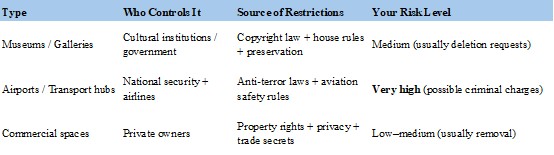
PART 1: Photography in Museums and Galleries
Why Do Museums Restrict Photography?
It’s not about being unfriendly—there are deeper reasons:
1. Copyright complexity.
While works like the Mona Lisa are in the public domain, exhibition design, lighting, wall text, and layout may still be protected. Temporary exhibitions are even stricter—loan agreements often explicitly prohibit photography.
2. Physical preservation.
Flash photography can cause cumulative damage to paintings, manuscripts, and textiles. Institutions like the Louvre and British Museum have long studied light exposure risks.
3. Commercial licensing.
Museums often partner with image agencies to sell high-resolution reproductions. Unrestricted photography can undermine this revenue stream.
4. Visitor experience.
If everyone livestreamed in front of The Starry Night, the space would no longer allow quiet appreciation.
Common Rule Types
Rules are usually layered:
✔ Photography allowed, no flash
✔ Personal use only (non-commercial)
✖ No tripods or selfie sticks
✖ No video or commercial shooting in certain areas
Three Easy Mistakes
1. “No sign means it’s allowed.”
Wrong. Restrictions can come from overlapping rules—building status, loan agreements, or local law.
2. Vlogging = commercial use.
Posting on TikTok or Instagram with monetization or branding may legally count as commercial activity.
3. Using photos for design work.
Textures, patterns, or artwork details used in commercial projects may violate rights—even if photography was allowed for personal use.
Practical Tips
l Check signage and website policies before shooting
l Ask clearly: “Are there any restrictions I should know about?”
l Separate personal vs. commercial intent
l Avoid photographing wall labels and exhibition text
PART 2: Airports and Transportation Hubs
Why Are Airports So Sensitive?
1. National security.
Airports are high-risk targets; photography can be interpreted as surveillance.
2. Sensitive infrastructure.
Security scanners, layouts, and procedures are protected information.
3. Multiple authorities.
Airports involve overlapping control—airport operators, airlines, immigration, and security contractors—all with different rules.
Common No-Photo Zones
l Security checkpoints
l Immigration/customs areas
l Crew-only zones
l Sometimes even airside areas entirely
Even in the U.S., where the Transportation Security Administration allows photography in theory, enforcement varies widely.
High-Risk Misjudgments
l Photographing “interesting” equipment (e.g., X-ray machines)
l Using telephoto lenses toward restricted areas
l Accidentally capturing security staff or operations
Practical Tips
l Check airport policies in advance
l Avoid photographing staff or security processes
l Use minimal gear (phones are safer than DSLRs in sensitive zones)
l Keep explanations simple if questioned: “Personal travel photos”
PART 3: Commercial Spaces
This is the most misunderstood category.
Shops, cafés, hotels—they’re open to the public, but legally private property. Owners decide what’s allowed.
Three Typical Models
1. Complete Photography Ban (Especially in High-End Brand Stores)
Luxury boutiques, independent designer shops, and tech showrooms often adopt this policy. The reasons include preventing design copying, protecting customer privacy, and maintaining brand exclusivity. If you raise your camera, staff will usually stop you immediately—this isn’t personal, it’s company policy.
2. Personal Photography Allowed (But No Commercial Use)
Most chain cafés, restaurants, and standard retail stores fall into this category. You can photograph your food, the décor, or yourself. However, if your photos are used for commercial purposes—such as professional reviews on platforms like TripAdvisor, promotional content, or brand collaborations on Instagram—you are exceeding the permitted scope.
3. Photography Allowed with Permission (Common in Hotels and Dining Venues)
Hotels are particularly complex. Lobbies, hallways, and restaurants are usually open to guest photography, but conference rooms, gyms, and spa areas often have separate rules. If you plan to shoot a wedding, product photos, or a vlog inside a hotel, you must obtain written permission from the marketing department in advance.
Common Conflict Points
l Photographing other customers (privacy risk)
l Filming menus or interiors for commercial content
l Vlogging without permission
l Using professional-looking equipment
Practical Tips
l Ask before shooting: “Is photography allowed here?”
l Confirm commercial use in writing
l Avoid capturing identifiable people
l Remember: hotel public areas ≠ unrestricted access
PART 4: What Happens If You Break the Rules?
Minor (Most Common)
l Asked to delete photos
l Verbal warning
l Told to stop
Best response: comply immediately.
Moderate
l Asked to leave (trespassing risk if you refuse)
l ID check or content review
l Being blacklisted
Severe (Rare but real)
l Police involvement (security zones)
l Legal penalties for privacy or copyright violations
l Civil lawsuits for commercial misuse
In extreme cases, travelers have faced detention or fines in countries like the United Arab Emirates or Greece for sensitive photography.
A Hard Truth
“I didn’t know” is not a valid legal defense in most countries.
The Three Golden Rules
1. Respect First
The rules may not always feel reasonable, but arguing on the spot won’t change them—it will only escalate the situation. It’s far safer to address any concerns afterward through an embassy, a lawyer, or even social media, rather than confronting staff in the moment.
2. Ask Before You Assume
If you’re unsure, ask. That simple question can serve as evidence that you had no malicious intent. If a dispute arises later, it can work in your favor.
3. Separate Personal vs. Commercial Intent
Personal keepsakes, social media sharing, and commercial content creation fall into three entirely different legal categories. Build the habit of getting written confirmation before any commercial shoot; for personal photography, avoid using professional gear or staging elaborate setups.
A Low-Risk Strategy for Travel Photographers
Before You Go: 30 Minutes of Research
1. Check embassy travel advisories. Resources like reports from the Overseas Security Advisory Council, guidance from the Foreign, Commonwealth & Development Office, and China’s consular service websites often highlight country-specific restrictions.
2. Review official venue websites. Museums, airports, and hotels usually list their photography policies in the FAQ sections.
3. Browse local photography communities. Subreddits like r/travel and r/photography, as well as local groups on Flickr, often provide recent, on-the-ground insights.
On Arrival (3-second rule)
l Look: signs, behavior of others, security presence
l Ask: if unsure
l Decide: unclear = don’t shoot
While Shooting
l Enable cloud backup (e.g., Google Photos)
l Use discretion with shutter sound
l Be ready to delete if asked
If Confronted
l Don’t argue, run, or resist
l Comply and apologize
l Document later if needed
Shoot safely. Travel smart. Get home without trouble.
FAQs
1. Can I take photos in a museum if others are doing it?
Not necessarily. Other visitors may be ignoring rules or operating under different permissions. Always check signage or ask staff directly.
2. Is phone photography treated differently from using a camera?
Legally, no. However, phones are often perceived as less intrusive, so enforcement may be more relaxed in practice.
3. Can I post travel photos on social media without permission?
For personal use, usually yes. But once monetization, sponsorship, or brand promotion is involved, it may be considered commercial use and require permission.
4. What should I do if security asks me to delete photos?
Comply calmly. Arguing rarely helps and may escalate the situation. If needed, you can address concerns later through proper channels.
5. Do I need permission to vlog in public-looking places like cafés?
Yes, if the space is privately owned. Even if it’s open to customers, the owner has the right to restrict filming—especially for commercial content.
References
1. Overseas Security Advisory Council. (2023). Travel safety reports and country-specific advisories. U.S. Department of State.
2. UK Foreign, Commonwealth & Development Office. (2024). Foreign travel advice.
3. International Council of Museums. (2022). Code of ethics for museums.
4. Transportation Security Administration. (2023). Guidelines on photography at airport checkpoints.
5. European Commission. (2022). Copyright and cultural heritage in the digital single market.
6. Dubai Civil Aviation Authority. (2023). Airport security and public conduct regulations.
7. World Tourism Organization. (2023). Tourist behavior and legal compliance guidelines.
About the Author
Oliver Grant
Focus: Legal Risks, Privacy, Real-World Incidents
Oliver Grant writes about the legal and ethical boundaries of photography, with a focus on privacy, liability, and real-world risk scenarios. His work examines what can go wrong—and how photographers can protect themselves before it does.
Editorial Transparency Statement
This article is based on publicly available regulations, institutional policies, and real-world travel scenarios. While every effort has been made to ensure accuracy and relevance, rules may vary by country, venue, and time. The content is intended for informational purposes and reflects a synthesis of current best practices rather than legal advice.
Disclaimer
This content does not constitute legal advice. Laws and regulations regarding photography differ significantly across jurisdictions and may change without notice. Travelers are responsible for verifying local rules and complying with applicable laws. The author and publisher are not liable for any consequences resulting from the use of this information.
Recommend:
You’re 0.3 Seconds Faster Than Your Camera—And That’s Why You Miss the Decisive Moment
Why Nobody Buys Your Photos—Even After You Upload Them Everywhere
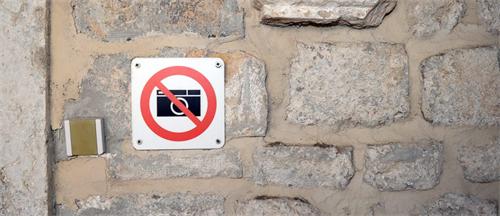
Your Camera Isn’t a Free Pass: Photography Boundaries in Museums, Airports, and Commercial Spaces — A Traveler’s Legal Survival Guide
Why Autofocus Struggles in Bird Photography (A Real-World Gear Test of Modern Camera Systems)