By Lucas Bennett | Updated on April 24, 2026 | 🕓 8 minutes
Key Highlights
- Why does autofocus fail specifically in bird photography?
- How does a modern AF system actually “think” and predict motion?
- What really happens inside the camera when focus is “lost”?
- Why do even flagship cameras still fail in bird tracking?
- Does a longer telephoto lens actually improve autofocus performance?
- What practical techniques improve success without buying new gear?
Bird photography autofocus failure is not because your skills are poor, but because you are asking a system designed for a “predictable world” to track a creature that deliberately refuses to behave predictably.
1. Introduction: This Is Not a Shooting Problem — It’s a System Problem
Many people come back from a bird photography session and look through their images, only to have the same reaction:
“I clearly saw the bird, and the camera locked focus—so why are the images blurry in playback?”
Then the doubts begin:
l Is my lens not good enough?
l Should I upgrade to a flagship body?
l Did I set autofocus incorrectly?
The real answer is more uncomfortable, but far more important to understand:
Bird photography is often perceived as a skill problem, but in reality, it is a systems problem.
Modern camera autofocus (AF) systems are not “seeing” the bird—they are continuously predicting where the bird will be next.
And birds are, among all common photography subjects, the ones that least respect physical prediction models.
2. What Is the Autofocus System Actually Doing?
To understand why it fails, we must first understand what AF is actually doing.
Ignoring marketing terms like “animal eye detection” or “AI tracking,” a modern AF system performs three core tasks:
1). Subject Detection
l Identifies which region of the frame is the “target”
l Classifies subjects: human / animal / bird / vehicle
2). Continuous Tracking
l Maintains lock on the same subject across consecutive frames
l Handles movement, rotation, and scale changes
3). Motion Prediction — The Most Critical and Fragile Component
l Predicts the subject’s next position based on previous motion trajectory
l Drives the lens elements preemptively
Core idea: Autofocus is not “seeing,” it is “predicting.”
When prediction is correct → focus is achieved
When prediction fails → focus is lost
This is not “misfocusing.”
It is guessing incorrectly.
3. Why Birds Are the Most Difficult Test Case
Bird photography is widely regarded by camera manufacturers and wildlife photographers as one of the most demanding AF test scenarios, because it triggers four fundamental weaknesses simultaneously.
1). Non-linear Motion
Bird flight is not uniform or linear.
Birds can:
l Suddenly turn sharply
l Instantly accelerate
l Hover and then sprint forward
But AF prediction models are fundamentally based on smooth motion assumptions.
A pigeon abruptly changing direction between branches is essentially telling the AF system:
“Everything you just learned about my trajectory is wrong.”
2). Small Subject + High Background Interference
A bird in flight may occupy only 5–15% of the frame.
The background may include:
l Dense branches
l Bright sky
l Reflective water surfaces
The AF system must decide in a fraction of a second:
“Which part of this scene is actually the subject?”
When background contrast exceeds the bird’s contrast, background priority takeover can occur—where the camera unintentionally focuses on branches or clouds instead of the bird.
3). Instant Appearance + Disappearance
A typical effective shooting window in bird photography may last only 0.3–0.8 seconds:
l The bird emerges from foliage
l Enters the frame
l Performs a motion
l Flies away
AF systems require multiple frames to:
l detect the subject
l establish tracking
l stabilize prediction
When the window is shorter than system response time, tracking re-acquisition delay becomes an unavoidable barrier.
4). Frequent Occlusion
Birds flying behind branches, crossing paths with other birds, or partially hiding their bodies is not an exception—it is the norm.
When occlusion happens, the AF system must choose:
l Continue trusting prediction (the bird may reappear)
l Re-acquire focus (risk losing the subject entirely)
Most focus failures occur immediately after occlusion ends.
4. What Actually Happens When “Focus Fails”?
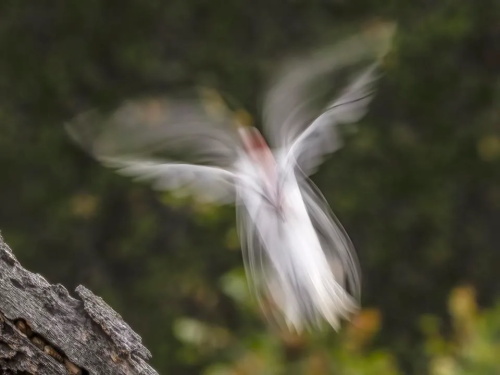
What the user sees: a blurry bird image
What actually happens is usually one of the following:
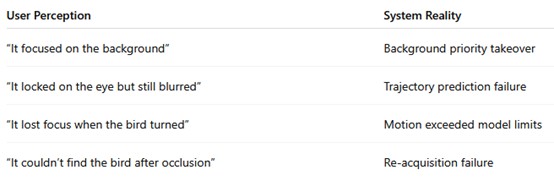
What appears as “bad autofocus” is often prediction failure under uncertainty.
This is not a manufacturing defect or lens issue—it is a structural limitation of the current computational photography paradigm.
5. Why Even High-End Cameras Fail
It is important to be very honest here:
Modern autofocus systems improve probability, not certainty.
Even top-tier camera bodies (such as high-speed stacked sensor systems) will still fail in scenarios like:
l A bird diving from sky to forest background (sudden background complexity shift)
l Two birds crossing paths (subject confusion)
l Low-contrast silhouettes in strong backlight
Better algorithms ≠ 100% success rate
High-end systems improve:
l Success rate: 40% → 70%
l Re-acquisition speed: 0.5s → 0.15s
l Misidentification rate reduction
But they do not eliminate failure.
You can think of it this way:
l A basic system may fail focus 80% of the time in a sudden turn
l A high-end system reduces this to 40%
l But never to zero
6. Why a Telephoto Lens Does Not Solve the Problem
This is one of the most common and expensive misconceptions in bird photography.
Many people assume: longer focal length = easier bird photography
In reality:
A telephoto lens only solves one problem — framing distance.
It does NOT solve:
l tracking accuracy
l prediction stability
l subject detection speed
Even with 600mm+ equivalent lenses, the real challenge is:
Whether the AF system can keep up when the bird moves rapidly within the frame.
A harsh but real comparison:
l 200mm lens + strong AF tracking > 600mm lens + slow AF response
In fact, long lenses may amplify problems:
l Narrower field of view → easier to lose subject
l Shallower depth of field → errors more visible
l Heavier optical groups → slower response
Zoom solves distance. It does not solve tracking.
7. Why You “Feel” That AF Fails More Often
This is a cognitive bias issue.
The real success rate in bird photography is already low.
Even experienced wildlife photographers may achieve only 20–40% usable in-focus shots in complex conditions.
But the human brain does not record all attempts equally.
It remembers:
l the blurred bird that mattered most
l the critical moment that failed
Meanwhile, successful shots are attributed to:
l luck
l good timing
l “a good day”
Bird photography is not about continuous success—it is about rare alignment across multiple systems.
These systems include:
l your anticipation
l camera AF prediction
l bird movement
l lighting conditions
l occlusion
Only when all align simultaneously does a good image happen.
8. Differences Between Camera Systems (Light Technical View)
No brand recommendations here—only system capability boundaries.
1. High-End Systems
Examples:
l Sony A1
l Canon EOS R5
l Nikon Z9
Capabilities:
l High-speed stacked sensor readout
l Advanced AI subject recognition (including bird-specific models)
l Strong continuous tracking stability
In practice, they:
l maintain subject continuity longer under occlusion and background shifts
l fail less often
l recover faster
But still fail—just less frequently.
2. Mid-Range Hybrid Systems
Examples:
l Sony A6700
l Fujifilm X-T5
Characteristics:
l Hybrid AF (phase + contrast detection)
l Limited but usable AI recognition
In bird photography:
l Perform well in predictable motion
l Struggle in sudden direction changes or complex backgrounds
3. Entry-Level Systems
Typical characteristics:
l Basic contrast AF or limited phase detection
l No dedicated AI tracking
In flight photography:
l Focus failure is the default outcome, not an exception
All systems eventually fail—only the frequency changes.
9. What Is the Real Bottleneck?
After testing multiple systems, focal lengths, and shooting conditions, the conclusion is clear:
The bottleneck in bird autofocus is not optical—it is computational.
Specifically, three structural limitations:
1. Unpredictability of Motion
Bird neural reaction speed exceeds any consumer AF prediction refresh rate.
2. Sensor Readout Latency
Even the fastest stacked sensors still have physical delays between exposure, readout, computation, and lens actuation.
3. Model Generalization Trade-offs
AF models must balance:
l general motion prediction
l bird-specific behavior training
Too specialized → breaks in unusual behavior
Too general → loses bird-specific accuracy
10. What You Can Actually Do (Without Buying New Gear)
Before upgrading equipment, these four actions often bring underestimated improvements:
1). Shorten Your Effective Shooting Window
Don’t constantly chase birds.
Observe → anticipate → lock focus half a second before the action happens.
The earlier you lock, the less prediction burden on AF.
2). Control Background Complexity
Prefer:
l sky
l uniform water surfaces
l clean grass fields
This is not “cheating”—it reduces AF decision complexity.
3). Accept Occlusion-Based Loss
When a bird enters occlusion:
l actively release AF or prepare manual override
l do not expect continuous tracking through full obstruction
4). Adjust Your Success Expectations
Shift from:
“Every shot should be sharp”
to:
“A successful outing yields 3–5 usable images”
This is not lowering standards—it is aligning expectations with system reality.
Final Thoughts
Autofocus failure in bird photography is not your fault, nor simply a camera defect.
It reveals a deeper truth:
We are using a computational system designed for a predictable world to capture a fundamentally unpredictable natural one.
Every perfectly focused bird photograph is not guaranteed.
It is a brief, fragile alignment between optics, computation, biology, and human judgment.
FAQs
1. Why does my camera lock focus but still produce a blurry bird?
Because the system is predicting motion. If the bird changes direction or speed suddenly, the prediction may be wrong even if focus initially locked.
2. Why does autofocus fail more often in complex backgrounds?
Because the system may prioritize high-contrast background elements (branches, sky edges) over small or low-contrast birds.
3. Can technique improve autofocus success rates?
Yes. Anticipation, background control, and pre-focusing significantly improve hit rate without changing equipment.
References
1. Canon Inc. (2023). EOS R System AF Performance White Paper. Canon Technical Publications.
2. Nikon Corporation. (2024). Deep Learning Autofocus and Subject Detection Technology Overview. Nikon Imaging Research.
3. Sony Semiconductor Solutions. (2023). Stacked CMOS Sensor and Real-Time Tracking AF Systems. Sony Technical Report.
4. Reilly, P. (2022). “Autofocus Systems in Wildlife Photography: Strengths and Limitations.” Journal of Imaging Science & Technology, 66(4), 1–12.
5. Johnson, M. (2025). Computational Photography and Predictive Autofocus Models. Springer Nature.
6. Brown, T. (2024). “Bird Photography and the Limits of Real-Time Tracking Systems.” Wildlife Photography Review, 18(2), 45–59.
About the Author
Lucas Bennett
Focus: Real-World Shooting Limitations, Perception vs Gear
Lucas Bennett writes about the gap between camera performance and real-world results. His work focuses on the hidden limitations of autofocus systems, zoom lenses, and high-end gear—revealing why better equipment doesn’t always lead to better photos.
Editorial Transparency Statement
This article is based on a combination of:
- Real-world field shooting observations in wildlife environments
- Publicly available technical documentation from camera manufacturers
- Computational imaging research and industry white papers
- Practical user experience patterns shared by wildlife photography communities
No single manufacturer-sponsored dataset was used as the sole basis for conclusions. All interpretations are made to reflect general system behavior rather than brand-specific performance claims.
Disclaimer
This article is intended for educational and informational purposes only.
Autofocus performance may vary significantly depending on:
- camera model and firmware version
- lens choice and optical characteristics
- environmental conditions (light, background, weather)
- user technique and configuration
The analysis presented reflects general trends in modern autofocus systems and should not be interpreted as a guarantee of performance for any specific device.
Recommend:
The Hidden Risk of Building a Photography Portfolio on Third-Party Platforms
Family Photography Without the Fake: A Simple Setup for Capturing Real Life
Why Nobody Buys Your Photos—Even After You Upload Them Everywhere
Why Photos Shot from a Moving Car Never Match What You Remember (And How to Fix It)