
—Why It Looks Busy, Why It Pays Poorly—and What Working Photographers Do Differently
By Ryan Mitchell | Updated on April 10, 2026 | 🕓 9 minutes
Key Highlights
- What makes event photography difficult to monetize consistently?
- Why is “reliability” more valuable than technical photography skill?
- How do hidden costs quietly reduce your real income?
- What are the three most effective channels to get your first paid event photography job?
- Why do reusable shot lists significantly improve client satisfaction and workflow efficiency?
- How can delivery structure and usage guidance increase perceived professionalism?
Imagine this scenario: you’ve just bought a decent camera, and someone on LinkedIn urgently needs an event photographer. You show up confident—only to find a corporate annual dinner with chaotic lighting. The stage is blasted by LED screens, the audience sits under warm chandeliers, and moving spotlights flash unpredictably. The event planner suddenly moves the award ceremony earlier, and you haven’t even switched lenses yet. A client walks over and says, “Get more candid shots—don’t make it look staged.”
You shoot for four hours and take 800 photos.
Back home, reviewing them: the key executives’ faces are either buried in shadow or tinted green by stage lights; you caught the award moment, but the background is messy; the “natural interactions” are full of blinking eyes or awkward mid-bite expressions. You barely manage to select 50 images and send them off. The client replies, “Thanks.” Then… nothing.
Three months later, you see the same company on LinkedIn hiring another photographer. The photos are completely ordinary—but the client writes a long thank-you post and tags the photographer.
This is the truth about event photography: the biggest problem isn’t shooting badly—it’s shooting a lot without delivering usable value.
Event photography is a global market—but also a global trap. It looks easy to enter, but those who consistently make money rely on a rarely discussed system: chaos management.
Part 1: Why Event Photography Looks Easy—but Is Hard to Profit From
1.1 The Illusion of Abundant Opportunities
Every day, in every city:
- Corporate annual events, product launches, industry conferences
- Weddings, birthday parties, private dinners
- Startup pitch events, workshops, networking meetups
Social media is full of posts like: “Urgently need an event photographer tomorrow afternoon.” It feels like high demand with low barriers—just own a camera and press the shutter.
That’s the trap.
1.2 The Real Competition Isn’t Skill—It’s Reliability
The event photography market has a brutal filter:
Clients pay a premium for “no mistakes,” not for occasional brilliance.
As a beginner, your competitors aren’t award-winning artists. They are:
- Photographers who’ve shot 50 similar events
- Familiar faces with existing client relationships
- Reliable operators who deliver consistently in chaos
Clients aren’t asking: “Can you take a stunning photo?”
They’re asking:
> “If I hire you, will you miss key people? Will your memory card fill up? Will you fail to capture the most important moment because you don’t understand the flow?”
So the real barrier isn’t technical skill—it’s chaos management: the ability to deliver usable results in unpredictable environments.
1.3 The “Busy Trap”: Why You Shoot Constantly but Earn Little
Many photographers fall into a cycle: fully booked every month, yet underwhelming income.
Problem 1: The ceiling of hourly pricing
Example: $100/hour × 4 hours = $400 per event.
Hidden costs:
- Pre-communication: 2–3 hours
- Travel: 1–2 hours
- Editing: 4–6 hours
- Gear maintenance
- Opportunity cost
Real hourly rate = quoted rate ÷ total time invested
Often closer to one-third.
Problem 2: Clients buy results—not time
Hourly pricing creates an “employee mindset”:
- “Can you stay longer?”
- “Take a few extra group shots”
- “Edit more photos?”
When you price based on deliverables, you sell solutions:
- Social media-ready images
- Website content
- Press-ready visuals
When clients pay for results, price sensitivity drops. When they pay for time, every minute is negotiated.
Part 2: Where Event Photography Actually Fails (What No One Tells You)
Most tutorials teach low-light autofocus—but ignore this truth:
80% of failures come from information chaos, not technical issues.
2.1 Not a Lighting Problem—An Information Black Hole
Photographers often arrive without knowing:
- Who must be photographed
- The real timeline
- What the photos will be used for
Consequences:
1. You captured images—but not the right ones
Example: client needs horizontal, clean-background press photos—but you shot artistic vertical portraits.
2. You’re in the wrong place at the right moment
Award moved earlier—you’re backstage. CEO speaks—you haven’t switched lenses.
Pre-shoot checklist (non-negotiable):
1. Who are the key people? (3–5 names)
2. What moments are critical?
3. Where will the photos be used?
2.2 “You Shot It—but It’s Unusable”
Technically fine ≠ commercially usable.
Common failures:
- No horizontal images
- No negative space
- Overly artistic composition
- No “safe shots”
Solution: Shoot 3 versions of every scene
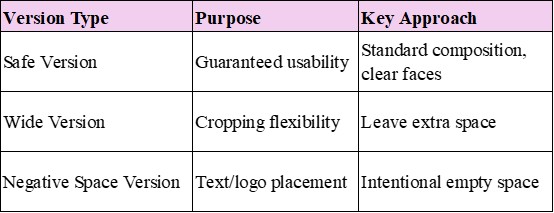
This alone can boost usability from 30% to 90%.
2.3 Timeline Collapse: The Real Disaster Zone
Delays are normal. Punctuality is rare.
- Speakers run late
- Agenda shifts
- Lighting changes
- Client requests surprise group shots
These aren’t accidents—they’re expected.
Strategies:
- Always be ready 10 minutes early
- Assume the timeline will fail
- Pre-identify 2–3 “safe shooting positions”
Part 3: Why Many Event Photographers Stay Busy but Broke
3.1 Pricing Models Define Your Ceiling
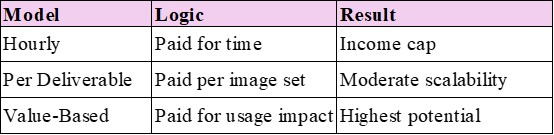
To scale, shift from time → value.
3.2 The “Repeat Client Paradox”
Event photography differs from other photography fields (such as weddings and portraits) in one key way: the logic of repeat business is fundamentally different.
Wedding photography: usually a once-in-a-lifetime event, but clients actively refer you to friends—referrals are the core growth driver
Portrait photography: clients may book annually, with a clear and predictable repeat cycle
Event photography: corporate clients host multiple events per year, but may hire different photographers each time; private clients may not host another event for years
This means that “repeat business” in event photography doesn’t come from waiting for clients to return—it comes from turning one-off jobs into long-term service relationships.
Practical strategy: design an “annual service package”
Instead of waiting for clients to contact you for each event, proactively propose:
“I noticed your company hosts industry events every quarter. I can offer an annual photography package that includes coverage for four events, annual photo library management, and priority rush delivery—at a 20% discount compared to booking individual events.”
This approach achieves three things:
1. Locks in long-term revenue: you don’t need to constantly find new clients every month
2. Reduces decision friction: clients don’t need to re-evaluate photographers each time
3. Builds deeper collaboration: you become familiar with their brand style, key people, and usage needs—leading to better and more consistent delivery
3.3 Hidden Costs Kill Profit
Many photographers struggle to understand their real earnings because event photography comes with significant hidden costs:
- Communication costs: it often takes 5–8 back-and-forth exchanges to finalize requirements
- Preparation costs: site visits, gear checks, timeline coordination
- Redundancy costs: backup camera bodies, lenses, memory cards, batteries—equipment depreciation is a real expense
- Health costs: late-night events, long shooting hours, extended standing—physical strain accumulates over time
- Payment risk: final payment collection rates are lower than in other fields, because “the job is already done,” reducing client urgency
Real cost calculation formula:
Actual Income = Quoted Price − Direct Costs (travel / equipment depreciation) − Hidden Costs (communication / preparation / redundancy / health) − Risk Costs (unpaid balances / disputes)
When you calculate using this formula, many jobs that seem “decent” on the surface turn out to have surprisingly low profit margins.
Part 4: How to Actually Start Getting Booked
4.1 Don’t Build a Portfolio—Build Sales Samples
Mistake: showcase “beautiful photos”
Reality: clients want usable scenarios
Create 3 scenario-based sample sets:
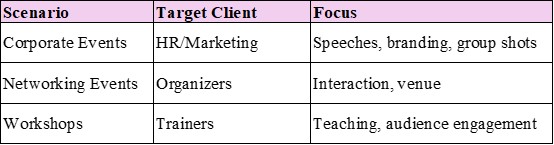
Consistency > creativity.
What if you don’t have any sample work?
- Shoot a friend’s event for free, specifically using the “three versions” approach
- Attend a public meetup or industry event and ask the organizer for permission to shoot
- Reach out to a nonprofit organization and offer free coverage in exchange for portfolio material and a testimonial
4.2 Where Your First Clients Actually Come From
Don’t start by bidding on photography platforms—they’re where price wars are the most brutal. And don’t spend money on ads either; your conversion rate likely isn’t high enough yet to justify the cost.
Channel 1: Event Organizers
These are people who consistently need photographers. As soon as one event ends, the next is already in planning. However, they usually already have go-to photographers—so how do you break in?
Don’t send a portfolio—send a solution.
Wrong approach:
“Hi, I’m a photographer. I shoot events. Here’s my portfolio.”
Right approach:
“I noticed you host startup meetups at XX venue every month. I’ve put together a photo structure tailored for this type of event (opening, interactions, talks, group shots). If your regular photographer is ever unavailable, I can step in as a backup and deliver consistent style with guaranteed turnaround.”
Channel 2: Venues
Hotels, coworking spaces, conference centers, galleries—they host events daily but usually don’t offer photography services. You can position yourself as their recommended vendor.
Action steps:
1. List 10 venues in your city that frequently host events
2. Visit them in person with your “scenario-based samples” (don’t email—show up)
3. Pitch: “I specialize in photographing events like the ones hosted here. If your clients ever need a photographer, I’d love to be added to your vendor list. In return, I can shoot a set of venue photos for your marketing at no cost.”
Channel 3: PR / Marketing Professionals (The Real Decision-Makers)
Inside companies, the people who decide whether to hire a photographer—and who to hire—are usually from marketing or PR. They have dedicated event budgets, and they’re buying content assets, not photography services.
Entry strategy:
Follow companies in your target industry. Look at the event photos they’ve recently posted on social media or their website. If the quality is average, that’s your opportunity.
Pitch template:
“I saw your coverage of last week’s industry conference. Adding more interaction shots and detail moments could significantly improve engagement. I specialize in B2B event photography—happy to share a sample set. If you have upcoming events, I can also provide same-day delivery for social media use.”
4.3 A Simple Booking System
Step 1: Specialize
Not “event photographer”
But “startup pitch events” or “corporate summits”
Step 2: Create a reusable shot list
Build a standardized checklist for each niche scenario. For example, a “startup pitch event shot list”:
- Before the event: empty venue shots, brand visibility, check-in desk, material details
- Opening: host close-ups, full venue wide shots, audience reactions
- Presentations: at least 3 angles per speaker (front, side, with screen in background)
- Interactions: audience questions, speaker responses, networking moments
- Closing: group photos, casual conversations, reset venue empty shots
This checklist serves two purposes:
1. Prevents missed shots: in a chaotic environment, you have a reliable checklist to follow
2. Builds professionalism: when clients see you using a structured list to confirm coverage, they perceive you as highly professional
Step 3: Standardize delivery
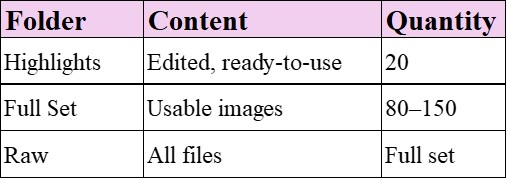
Naming: `Date_Client_Event_001`
Include usage instructions:
“The Highlights folder is ready for immediate use on social media or your website. The Full Set allows you to select additional images as needed. All photos are organized by scene. If you require specific formats (such as print or large-format use), let me know—I can provide high-resolution versions.”
This small detail can significantly elevate the client experience. Most photographers simply send a download link and call it done, but by providing guidance on how to use the images, you demonstrate a higher level of professionalism.
Part 5: Why the Best Event Photographers Don’t Look Busy
5.1 They Charge for Certainty
- Backup systems
- Experience
- Fast delivery
They sell risk reduction, not photos.
5.2 They Become Coordinators
- Work with assistants
- Collaborate with planners
- Anticipate problems
Shift from:
- “I take photos”
→ “I ensure your event is visually covered without risk”
5.3 They Treat It as a Cash Flow Business
Smart strategy:
- Years 1–2: grind and build
- Year 3+: expand into:
- Retainer branding work
- Video production
- Education/workshops
Final truth:
Event photography doesn’t pay for pressing the shutter.
It pays for handling uncertainty—and delivering certainty.
FAQs
Q1: Can I start without a portfolio?
Yes. You can build sample work through free events, meetups, or nonprofit collaborations.
Q2: How long does it take to become profitable in event photography?
It varies, but most photographers only become stable once they move from one-off gigs to repeat clients or retainers.
Q3: Is event photography a good full-time career?
It can be, but long-term stability usually depends on expanding into retainer clients, brand work, or related services like video.
Q4: Why do clients often switch photographers even if they are satisfied?
Because many clients prioritize convenience, availability, or vendor relationships over long-term loyalty.
References
1. Barnbaum, B. (2017). The art of photography: A personal approach to artistic expression (2nd ed.). Rocky Nook.
2. Kelby, S. (2020). The business of photography: Principles and practices. Rocky Nook.
3. Upton, B., London, J., Stone, J., & Kobre, K. (2018). Photography (12th ed.). Pearson.
4. Grecco, J. (2019). Lighting and workflow for event photography. Amherst Media.
5. Guillebeau, C. (2015). The $100 startup: Reinvent the way you make a living, do what you love, and create a new future. Currency.
About the Author
Ryan Mitchell
Focus: Freelance Photography, Client Work, Pricing
Ryan Mitchell focuses on the business side of photography, including client work, pricing strategies, and freelance survival. His writing breaks down how photographers turn skills into sustainable income in competitive markets.
Editorial Transparency Statement
This article is based on a synthesis of practical field experience in event photography, combined with established industry practices in commercial photography, client management, and service-based business models. No specific client data or confidential project information has been disclosed. All examples are generalized and illustrative to reflect common industry scenarios.
Disclaimer
This content is for informational and educational purposes only. It does not guarantee income, client acquisition, or business success. Photography markets vary significantly by region, competition level, and individual skill set. Readers should adapt strategies based on their own circumstances and professional judgment.
Recommend:
Why Low-Light Autofocus Fails—and Which Cameras Handle It Better
Why Photos Shot from a Moving Car Never Match What You Remember (And How to Fix It)

How to Become a Wedding Photographer (and Actually Survive It)
Why Nobody Buys Your Photos—Even After You Upload Them Everywhere