
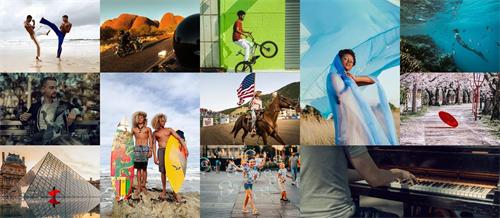
——Stock Photography vs Direct Clients: Where the Money Really Comes From
By Daniel Hayes | Updated on April 05, 2026 | 🕓 12 minutes
Key Highlights
- Why do stock photographers upload thousands of images but still earn very little?
- What makes a photo “sellable” in the stock photography ecosystem?
- How does platform structure affect visibility and income distribution?
- What separates photographers who succeed commercially from those who don’t?
- How can you shift from “uploading images” to building a usable visual business?
- What practical steps help turn photography into client-driven income?
I. A Counterintuitive Reality
In public shares from some photographers, we can see comparisons like this:
One photographer uploaded over 3,000 images across stock platforms, yet after years their total income remained at a “low single-digit monthly revenue” level.
Meanwhile, another photographer maintained only about 200 carefully selected works, yet through commercial collaborations, brand shoots, and content licensing, achieved annual revenues in the tens of thousands of dollars.
Their shooting subjects were even highly similar: urban landscapes, lifestyle scenes, portraits, and natural light environments.
The difference is not technical ability, nor entirely effort level.
The real difference lies in:
How the income structure is designed.
If you are experiencing a phase where “you upload a lot, but income barely changes,” this is not an individual problem—it is a system problem.
The reason many people get stuck is not that they “don’t understand,” but that they keep “uploading” without ever building a “feedback loop.”
II. The Real Economics of Stock Photography
2.1 Supply Explosion and Visibility Collapse
Mainstream stock platforms are growing extremely fast, with overall libraries reaching hundreds of millions of images.
This means even if you upload 1,000 images, you are still only a tiny fraction of the ecosystem.
More importantly, ranking mechanisms in stock platforms are usually influenced by:
l Historical downloads
l Click-through rate
l Conversion rate
This leads to a typical phenomenon:
New work struggles to gain initial visibility
This is not platform bias, but a natural outcome of the subscription business model—platforms must prioritize content that is more likely to be downloaded.
You can run an immediate test:
Open any 10 of your stock images and ask three questions:
If I were a buyer, what keywords would I use to find this?
Does this image have a “clear use case”? (advertising / blog / cover)
Is it a “repeatable scenario” or a one-off aesthetic moment?
If you cannot answer 2 or more of these:
This image is essentially a “non-monetizable asset” in the stock system.
2.2 The Reality of Pricing Structure
In today’s stock ecosystem, photographer income mainly comes from three models:
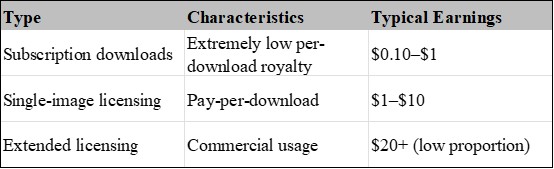
In a subscription-dominant environment, most downloads are diluted into extremely low unit prices.
Therefore, a reasonable industry projection is:
If the target annual income is $20,000–$30,000,
it requires a very high volume of downloads to support it.
This is also why many photographers feel:
“Uploads keep increasing, but income remains flat.”
2.3 Who Actually Survives in Stock Photography?
Based on observation, stable earners in stock platforms usually fall into three categories:
1) Scaled producers
Team-based operations producing content in bulk, relying on efficiency at scale.
2) Niche photographers
Such as medical, industrial, or safety-related visual content with higher entry barriers.
3) Early entrants
Those who accumulated large download history in the early days of platforms and benefit from long-term traffic advantages.
For individual photographers entering later, stock photography is more like:
A low-certainty long-tail income supplement, not a primary income source.
Practical: How to Make Stock Photos “Start Having a Chance to Sell”
Step 1: Shift from “beautiful images” to “usable scenes”
Don’t shoot:
- landscapes
- emotions
- random street photography
Start shooting:
- remote work
- small business
- fitness routine
- modern lifestyle
Step 2: One shoot = one “search intent”
Wrong approach:
- Shoot 30 unrelated images
Correct approach:
- One theme × 10–20 variations
Example:
- “freelancer workspace”
Includes:
- top-down desk shots
- hands typing on keyboard
- coffee + laptop
- phone + planner
Step 3: Keywords are not descriptions—they are search terms
Not:
- beautiful coffee
- nice light street
But:
- remote work coffee laptop
- morning productivity home office
- urban lifestyle minimal workspace
Step 4: Weekly minimum action (very important)
If you only do one thing:
Create 1 complete “scene pack” per week (10+ images)
After 3 months, you will start seeing system feedback.
III. The Hidden Value of Direct Clients
3.1 What “Direct Clients” Means
Direct clients are not limited to wedding or portrait clients. They include:
l Brand marketing teams
l Editorial and publishing agencies
l Advertising and design agencies
l Content creators and media teams
Their shared characteristic is:
They need “ready-to-use visual solutions,” not individual images.
3.2 Why Direct Clients Pay More
From the client perspective, stock photography cannot provide core value in several areas:
① Time certainty
Clients are not just buying images—they are buying “fast task completion.”
Filtering thousands of stock images is itself a cost.
② Reduced usage risk
Commercial usage involves:
l Licensing scope
l Model release rights
l Location permissions
Stock images often require additional risk evaluation.
Custom shoots provide clear licensing structures.
③ Long-term relationship value
Stock transactions are one-off behaviors.
Direct collaboration often evolves into:
l Repeat projects
l Long-term content partnerships
l Referral clients
Income shifts from “single transactions” to “relationship networks.”

How to Find Your First Client (from zero)
Step 1: Don’t look for clients—look for “people already buying visuals”
Not:
- find brands
- find companies
- find big clients
But:
- people already posting on Instagram / websites / ads with clearly inconsistent visual quality
Open Instagram / LinkedIn:
Criteria:
- post regularly
- have products/services
- visually low-quality imagery
Step 2: Don’t sell—do a “visual diagnosis”
Don’t say: “I can shoot for you”
Say: “I looked at your recent content and noticed a few visual improvements (free feedback for reference).”
Step 3: Send “comparison-based references”
Replace their current visual style with yours
For example:
their current: low-quality product photo
your proposal: clean white background + lifestyle scene
Step 4: Real goal of the first job
Don’t think about money
The goal is: “build a usable commercial case study”
IV. From Stock Thinking to Commercial Photography Thinking
4.1 Redefining the Portfolio
Traditional photographers organize work by “location / time / type.”
But commercial clients care more about:
l Is it suitable for social media?
l Is it suitable for ads?
l Is it suitable for brand content?
Therefore, portfolios should be organized by “use cases.”
For example:
l Social media content
l Brand visual assets
l Editorial imagery
4.2 Structural Shift in Channels
Pure display platforms (such as image communities) often serve photographers, not clients.
More effective directions include:
l Professional networks (e.g., LinkedIn)
l Industry communities
l Email lists
Core logic:
Shift from “passive search exposure” to “entering decision-making pathways.”
Realistic success rate:
10 outreach → 1 response
3 responses → 1 potential collaboration
1 collaboration → real case study created
V. Hybrid Model: A More Realistic Path
Many successful photographers eventually adopt a hybrid structure:
l Stock photography as long-term supplemental income
l Commercial shoots as core income source
Even the same shoot can serve both:
l commercial clients
l long-tail stock revenue
The key is:
Whether you design for “multi-purpose usage” at the moment of shooting.
If You Are Stuck: A 7-Day Reset Plan
Days 1–2:
Organize your existing photos into “beautiful” vs “usable.”
Days 3–4:
Choose one clear scenario (e.g., home office / fitness / food delivery).
Day 5:
Shoot one complete usable scene set.
Day 6:
Upload and optimize keywords (focus on usage intent).
Day 7:
Observe 10 potential users (not to sell, but to understand demand).

VI. Conclusion: The Real Divide in Photography Commercialization
The silence of stock photography does not mean your work lacks value.
It is more of a reminder of one reality:
In an environment of extreme supply abundance, value is defined not by “creation,” but by “usability.”
The essence of photography income has never been “selling photos,” but:
Reducing the cost and risk for others to complete a task.
When you start defining an image by “use” rather than “beauty,” you are no longer just a photographer—you become a provider of visual solutions.
FAQs
1. Is stock photography still worth it in 2026?
Yes, but mainly as a long-tail supplemental income source rather than a primary revenue stream for most photographers.
2. Do I need expensive equipment to succeed in commercial photography?
No. Commercial success depends more on solving client needs than on camera gear.
3. What type of photos sell best on stock platforms today?
Usable, context-driven scenes such as remote work, business workflows, fitness routines, and lifestyle environments.
4. How do direct clients usually find photographers?
Through referrals, social media presence (especially LinkedIn and Instagram), portfolios, or direct outreach.
5. Can one photo be used for both stock and client work?
Yes. Many photographers design shoots as “multi-purpose assets” for both stock libraries and commercial licensing.
References
1. Adobe Stock Contributor Portal. (2024). Contributor earnings and licensing overview. Adobe Inc. [https://contributor.stock.adobe.com]
2. Getty Images. (2023). Contributor royalty structure and licensing models. Getty Images Inc. [https://contributors.gettyimages.com]
3. Microstock Group. (2024). Stock photography market trends and contributor insights. [https://www.microstockgroup.com]
4. Statista. (2025). Digital stock image market revenue worldwide. Statista Research Department. [https://www.statista.com]
5. Shutterstock Contributor Resources. (2024). How royalties and search ranking work. Shutterstock Inc. [https://submit.shutterstock.com]
About the Author
Daniel Hayes
Focus: Monetization Models, Platforms, Creative Income
Daniel Hayes explores different monetization paths in photography—from stock platforms and content licensing to online portfolios and creator economies. His work analyzes how photographers build income streams beyond traditional client work.
Editorial Transparency Statement
This article is based on observed industry patterns, publicly available contributor reports, and aggregated professional experiences within the stock photography and commercial photography ecosystem. While examples and scenarios are illustrative, they reflect common structural dynamics rather than isolated cases.
The goal of this content is to provide educational insight into photography monetization models and is not intended as financial or career advice tailored to individual circumstances.
Disclaimer
The information provided in this article is for educational and informational purposes only. Earnings, performance outcomes, and market behavior in stock photography and commercial photography may vary significantly depending on geography, experience level, niche selection, platform algorithms, and external market conditions.
No guarantees of income or commercial success are implied or promised. Readers are encouraged to conduct their own research before making business or career decisions.
Recommend:

Why Autofocus Struggles in Bird Photography (A Real-World Gear Test of Modern Camera Systems)

Why Sharpness Doesn’t Fix Boring Plant Photos (Even with Expensive Gear)

How to Build a Travel Camera Kit You’ll Actually Use (Not Just Carry Around)

You’re 0.3 Seconds Faster Than Your Camera—And That’s Why You Miss the Decisive Moment