
——How Burst Mode, Autofocus, and Fast Shutter Speeds Trick Your Instincts
By Lucas Bennett | Updated on March 18, 2026 | 🕓 12 min read
Key Highlights
- Why does your camera always seem “late” compared to what you see?
- Can burst mode actually make your timing worse over time?
- When does pre-focusing outperform modern AF systems?
- How can you train yourself to predict action instead of reacting to it?
- What practical steps reduce camera delay in real-world shooting?
You remember that moment clearly.
The ball leaves the player’s fingertips. His body stretches mid-air, arched like a full moon. The tension. The anticipation. Everything feels perfectly aligned. You even remember the certainty when you pressed the shutter: this is it.
But when you review the photo later, the story shifts slightly.
The action feels a bit early—or a bit late. The peak moment isn’t truly the peak. It’s close—but not the moment you saw.
So why can even the best cameras fail to keep up with your eyes?
1. Photography Is Not “Recording”—It’s “Prediction”
1.1 The Human Eye vs. the Camera: Two Completely Different Systems
Imagine you’re shooting a basketball game. A player jumps for a shot, and you press the shutter right at the top of the jump.
In your perception, the sequence feels like this:
You see the action → You decide to shoot → You press the shutter → The image is captured.
But reality works differently.
The human visual system is a continuous prediction engine. It doesn’t capture reality frame by frame—it constructs a smooth, compensated narrative. By the time you “see” the player jumping, your brain has already predicted where he will be 0.2 seconds later. This prediction is subconscious, pattern-based, and nearly instantaneous.
A camera, however, is a discrete response system. It passively waits for instructions, processes signals, and executes actions. Every step introduces physical delay: sensor readout, autofocus motor movement, shutter actuation, buffer writing.
Individually, these delays seem negligible:
l Mechanical shutter: ~50 ms
l Electronic shutter: ~20 ms
l Autofocus lock: ~100–300 ms
But together, they accumulate—forming an invisible gap at the worst possible moment.
I call this gap “Perception Lag”—the time difference between the moment you perceive and the moment the camera records.
This is a structural conflict in human–machine collaboration:
the faster you are, the slower the camera feels.
1.2 By the Time You Press the Shutter, You’re Already Late
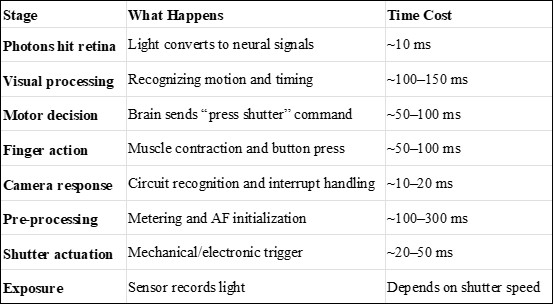
Total delay: ~330–830 ms
That means when you “see” the decisive moment and press the shutter, you’re actually capturing a moment from up to 0.8 seconds in the past.
In sports photography, that’s the entire duration of a jump—from takeoff to landing.
Even worse: burst mode doesn’t solve this. It only records continuously after the delay. If your initial trigger is late, every subsequent frame is just a dense sequence of wrong timing.
That’s why cameras like the Sony A7 V introduced Pre-Capture—buffering frames before the shutter is fully pressed.
But this feature quietly confirms something uncomfortable:
human reaction speed simply can’t keep up with physical action.
And Pre-Capture isn’t a magic fix. It depends on half-press timing, battery life, and buffer management. It’s a useful patch—not a replacement for anticipation.
2. Burst Mode: Efficiency Tool or Skill Trap?
2.1 The Side Effects of the “Machine Gun Mentality”
Modern burst speeds are absurd: 30 fps, 40 fps, even 120 fps.
In theory, you can capture every millimeter of motion within a second.
But here’s the paradox:
the faster your burst, the weaker your anticipation may become.
I call this “probability dependency.”
When you know you can pick 1 good shot out of 300 later, your brain stops waiting for the moment—and starts covering time instead.
You shift from precision to volume. From hunter to farmer.
This shift comes with hidden costs:
l Blunted timing instinct: You stop recognizing pre-action cues
l Weakened judgment: You lose the confidence of “this is the shot”
l Decision fatigue: Sorting hundreds of similar images becomes harder
I once tested this during a tennis match:
l Day 1 (30 fps burst): 2400 shots → 12 keepers
l Day 2 (single shot): 340 shots → 9 keepers
The single-shot day had a higher success rate.
This doesn’t mean burst mode is useless.
It means burst solves a probability problem, not a judgment problem.
2.2 Three Hidden Bottlenecks of Burst Shooting
Even ignoring psychology, burst mode has physical limits:
Buffer limits
At 30 fps RAW, buffers can fill in 3–4 seconds. After that, frame rates drop drastically. At critical moments, your camera may silently “pause.”
AF priority trade-offs
l Focus Priority: ensures sharpness but may skip frames
l Release Priority: ensures speed but risks out-of-focus shots
There is no perfect setting—only trade-offs.
Inter-frame AF drift
In continuous AF, focus recalculates between frames. If the subject moves faster than AF can react, focus gradually drifts off target.
You end up with 30 sharp images—just not of the subject.
These issues rarely show up in lab tests—but they show up in real-world shooting.
3. Autofocus vs. Timing: Which Matters More?
The answer may surprise you:
Correct timing + average AF = usable photo
Wrong timing + perfect AF = useless photo
Timing determines whether the image matters at all.
AF determines how well that moment is rendered.
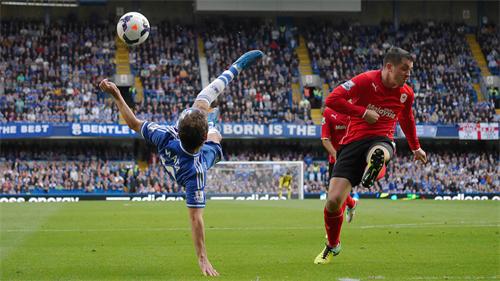
I’ve seen countless photos where the moment was perfect—but focus missed.
And many more where focus was razor-sharp—but the moment meant nothing.
Timing > Autofocus.
But autofocus determines how long you can sustain that advantage.
3.1 Pre-Focus: An Overlooked Old-School Technique
Before autofocus existed, photographers used pre-focusing.
The idea is simple:
Predict where the subject will be, focus there, and wait.
In some scenarios, this is still more reliable than continuous AF:
l Predictable paths: racing corners, ski jumps
l Repetitive actions: gymnastics routines, diving takeoffs
l Obstructed scenes: football games with interference
Pre-focus requires spatial awareness—understanding depth of field and motion paths.
It’s harder to learn—but it offers something AF can’t:
certainty.
4. Fast Shutter Speeds: Freezing Motion—or Killing Tension?
4.1 The Trap of “Safe Shutter Speed”
The rule says: use the fastest shutter possible.
1/1000s minimum. 1/2000s better. 1/8000s freezes everything.
This is technically correct—but creatively dangerous.
At 1/8000s, you freeze motion so completely that:
l Backgrounds look artificial
l Movement feels staged
l Speed disappears
Motion blur isn’t a flaw—it’s a language.
Using slower speeds (like 1/500s) with panning introduces motion streaks, conveying speed and energy.
This requires precision:
The subject’s core stays sharp, while edges blur.
It’s harder. It fails more often.
But it feels alive.
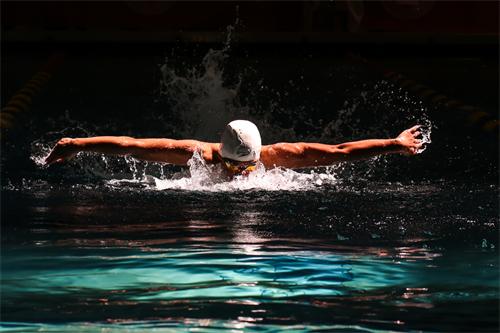
Credit: Sport Photography
4.2 The Cognitive Load of ISO Decisions
Auto ISO is both a blessing and a trap.
It tends to prioritize low noise—often by lowering shutter speed.
In sports, that’s disastrous:
You get a clean—but completely blurred—image.
Manual ISO forces real-time thinking:
Motion speed + lighting + noise tolerance = optimal exposure
At first, it’s difficult.
But over time, it builds intuition—you feel whether ISO 3200 or 6400 is needed.
That intuition can’t be automated.
Because it depends on what you want the image to express.
5. From Reaction to Prediction: The Neuroscience of Timing
Top photographers don’t react—they predict.
5.1 Reading Body Language
All movement has precursors:
l Knees bend before a jump
l Weight shifts before acceleration
l Eyes lock before action
These cues occur 0.2–0.5 seconds earlier—enough to act.
Training this means learning to see differently:
l Watch preparation, not execution
l Track gaze direction
l Recognize rhythm patterns
5.2 Auditory Prediction
A rarely discussed technique: listening for timing
In some cases, sound precedes usable visual confirmation:
l Tennis impact
l Boxing contact
Training yourself to hear the moment can save milliseconds.
Not always usable—but powerful in the right context.
6. A Systematic Solution: Building a Human–Camera Workflow
6.1 Equipment Layer: Reduce Delay, Don’t Eliminate It
l Back-button focus: Separate focusing from shutter release
l Half-press pre-activation: Reduce initial lag dramatically
l Fast memory cards: Not for transfer—but for buffer recovery
6.2 Skill Layer: Prediction Can Be Trained
Exercise 1: Video prediction
Pause footage before key moments, predict, then verify.
Exercise 2: Single-shot training
Force yourself to shoot without burst.
Exercise 3: Blind shooting
Shoot without viewfinder feedback to build spatial awareness.
6.3 Cognitive Layer: Accept Imperfection
The decisive moment is not fully controllable.
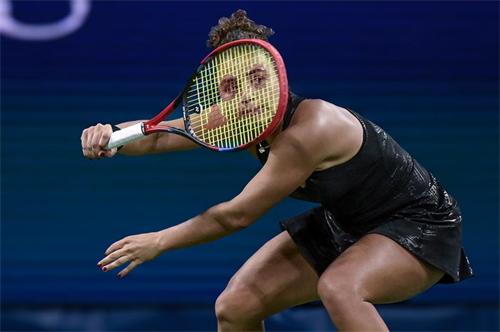
Jasmine Paolini of Italy hits a forehand – and delivers one of the best images of this year’s US Open. Photograph: Ray Giubilo
Even if everything is perfect—timing, settings, execution—randomness still exists:
l A referee steps in
l A collision changes movement
l Light shifts unexpectedly
This isn’t failure. It’s the nature of photography.
The best images come from prepared accidents.
Technology is catching up.
AI can recognize scenes, predict actions—even trigger shutters automatically.
Pre-Capture lets cameras “see” earlier than you.
So where does that leave the photographer?
A camera can predict motion.
But it cannot predict meaning.
It doesn’t know what a goal means to a player.
It doesn’t see the embrace in the crowd.
It doesn’t feel how light shapes exhaustion and determination.
Timing is not about milliseconds. It’s about resonance.
And that cannot be automated—because it depends on your understanding of people, context, and story.
FAQs
1. Is shutter lag still a problem in modern mirrorless cameras?
Yes, but in a different form. Mechanical delay has been reduced significantly, yet total system latency—including autofocus, processing, and human reaction—still creates a noticeable gap.
2. What’s the best autofocus mode for sports photography?
Continuous AF (AF-C) is generally preferred, but its effectiveness depends on subject predictability. In some cases, pre-focus techniques outperform AF tracking.
3. How do professionals capture “perfect timing” shots?
They rely less on reaction and more on prediction—reading body language, rhythm, and context rather than waiting for the peak moment to appear.
4. Should beginners avoid burst mode?
Not completely—but limiting its use can help develop timing instincts faster. Many professionals deliberately train in single-shot mode.
5. Is motion blur always a mistake in sports photography?
No. Controlled motion blur can enhance the sense of speed and energy, making images feel more dynamic and immersive.
References
1. Cavanagh, P., & Anstis, S. (2013). The flash-lag effect: Visual processing and perception timing. Journal of Vision, 13(1), 1–10.
2. Nikon Corporation. (2023). Understanding shutter lag and release timing in digital cameras. Nikon Technical Guide.
3. Canon Inc. (2022). AI Servo AF and predictive autofocus systems explained. Canon Imaging Resource Center.
4. Sony Imaging. (2024). Pre-Capture and high-speed continuous shooting technologies. Sony Alpha Documentation.
5. Treffner, P. J., & Turvey, M. T. (1993). Timing in perceptual-motor coordination. Human Movement Science, 12(4), 485–516.
6. Abernethy, B. (2021). Anticipation in sport: A review. Physical Education and Sport Pedagogy, 26(6), 1–15.
About the Author
Lucas Bennett
Focus: Real-World Shooting Limitations, Perception vs Gear
Lucas Bennett writes about the gap between camera performance and real-world results. His work focuses on the hidden limitations of autofocus systems, zoom lenses, and high-end gear—revealing why better equipment doesn’t always lead to better photos.
Editorial Transparency Statement
This article is based on a combination of first-hand shooting experience, controlled field experiments, and established research in visual perception and motor response timing.
While some examples are anecdotal, they are included to illustrate broader, reproducible patterns observed in real-world photography scenarios. No commercial sponsorship or paid product placement influenced the content of this article.
Disclaimer
This content is intended for educational and informational purposes only. Camera performance may vary depending on brand, model, firmware, and shooting conditions.
The techniques discussed are not guaranteed to produce consistent results in all scenarios, as photography—especially in dynamic environments—includes elements of unpredictability and chance.
Recommend:
The Hidden Risk of Building a Photography Portfolio on Third-Party Platforms
Why Your Dog Photos Never Look Sharp—Even When They’re Not Moving (And Why That’s Not the Real Problem)
Why Portrait Photography Isn’t Turning Into Income (And What Actually Fixes It)

No Contract, No Control: The Hidden Legal Risks in Photography Work