By Oliver Grant | Updated on March 26, 2026 | 🕓 12–15 minutes
Key Highlights
- What do photographers actually “own” when they build portfolios on third-party platforms?
- How do algorithm changes restructure the visibility and meaning of photography work?
- Why can platform-driven exposure unintentionally fragment a curated photo series?
- Why is relying solely on social platforms considered a “borrowed traffic funnel”?
- What are the three layers of a resilient photography portfolio system?
Many photographers believe: “As long as I upload enough work, I’m building my portfolio assets.”
But in reality—
You may only be “renting a display cabinet,” not “owning a gallery.”
The distinction seems subtle, but it is critical. When you pour years of work into a personal profile on Instagram, Behance, 500px, or Redbook, what you actually gain is a display space strictly constrained by platform rules. You can decorate it, but you do not own it; you can use it, but you must comply with terms that can change at any time.
And when platform rules change, what photographers lose is often not exposure—but control: control over how their work is seen, interpreted, and discovered.
1. You Think You’re “Building a Portfolio”—You’re Actually Training a Platform System
This is a rarely discussed reality in photography communities: every upload you make feeds the platform’s content ecosystem.
When you upload carefully edited photographs to any third-party platform, several things typically happen:
l The platform uses these images to train recommendation algorithms, learning “what kind of visual content keeps users engaged”
l It performs style recognition and auto-tagging, determining who should see your work
l Your content is incorporated into broader distribution models optimized for user retention and advertising revenue
You receive exposure opportunities, but the platform receives:
Content assets — massive volumes of visual data
User behavior data — who viewed, how long they stayed, whether they engaged
Style intelligence — quantifiable understanding of visual trends
These assets are far more valuable than the likes you receive individually. The issue is: this exchange is neither explicitly disclosed nor fairly priced.
User Value Insight: Work ≠ Clearly Defined Ownership
Photographers need to understand a basic fact: uploading content to a platform does not equal owning its presentation rights within that system. Terms of service usually grant platforms a broad usage license—not ownership transfer, but enough rights to reuse, process, and adapt content in ways you may not anticipate or explicitly approve.
Practical Reflection
Ask yourself:
If the platform suddenly removed export functionality today, what would you actually be able to recover?
Not “roughly the images,” but a structured, reconstructable portfolio with full metadata and narrative order. If the answer is unclear, you are already exposed to risk.
2. Hidden Risk 1: Algorithm Changes Don’t Just Reduce Exposure—They Rebuild Your Work’s Structure
Photographers usually notice changes in a very visible way:
l Fewer views
l Lower engagement
l Reduced likes
But what actually happens is deeper: a structural rewriting of your work’s visibility.
Your Work Gets Reordered
Platform feeds do not respect your intended sequence. A carefully curated emotional progression—dark to light, or introduction to climax—may be interpreted as independent images, each tested for engagement individually.
The result: viewers may see your series out of order, partially, or fragmented across different audiences.
Your Style Gets Downgraded or Hidden
Platforms periodically adjust content preferences. A “cinematic tone” that was once promoted may later be deprioritized in favor of “brighter, ad-friendly visuals.” Your work hasn’t changed—but the definition of “good content” has.
Recommendation Shifts Break Portfolio Continuity
When platforms move from “following-based feeds” to “interest-based recommendations,” your long-term audience may never see your updates. Your portfolio is no longer a destination people visit, but a pool of assets algorithmically sampled.
Real Impact
A complete series becomes:
Fragmented — images distributed across different audiences
Reordered — arranged by predicted engagement, not narrative intent
Decontextualized — no viewer sees the full story
For photographers, curation is essential. It gives meaning through sequence and structure. Algorithms systematically erode that curatorial control.
Practical Advice
Periodically do this:
Export and document your “original portfolio structure,” including narrative order.
Specifically:
l Maintain a local “portfolio narrative document” describing intent, sequence, and relationships between works
l Do not rely on platform albums or collections as your only organizational system
l Every six months, check whether platform presentation still matches your original curatorial intent

3. Hidden Risk 2: Migration Costs Are Extremely High—But Rarely Recognized
When you try to leave a platform—or are forced to (account issues, shutdowns, regional restrictions)—you discover a harsh reality:
Downloading your data ≠ Rebuilding your portfolio
Platforms typically provide:
l Image files (often compressed, not originals)
l Partial text descriptions (formatting lost)
l Engagement data (likes, comments, but not structurally useful)
But what you actually lose is:
l Layout and visual rhythm — spacing, cover choices, thumbnail decisions
l Sequence and narrative structure — curatorial logic
l External link network — embedded references, collaborations, media mentions
Deeper Issue: Three Layers of Portfolio Assets
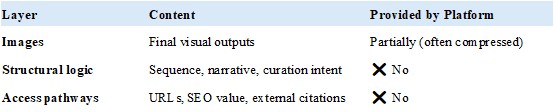
The third layer is the most overlooked and hardest to recover. Once external links point to your portfolio in articles or proposals, their value depends on permanent accessibility. If the platform changes URL structures or shuts down, the entire link ecosystem breaks.
Practical Advice
Every quarter:
Create a “portfolio mirror backup”—not just images, but structure.
Do this:
l Archive key portfolio pages using tools like the Wayback Machine
l Save screenshots + HTML structure of portfolio layouts
l Maintain a portfolio index sheet: project name, series, links, backup status, references
l For important projects, create offline PDF portfolios as archival copies
4. Hidden Risk 3: Platform Rule Changes Alter Your Work’s “Identity”
This is one of the most subtle risks: platform rules can change the identity of your work itself.
Platforms may adjust:
l NSFW policies — images considered artistic in one context may be flagged or removed elsewhere
l Commercial restrictions — promotional content may be limited or required to use official channels
l Tag systems — styles you rely on may be redefined or removed
l Regional visibility — content may become inaccessible in certain countries
Result
The same body of work may:
l Be classified differently across regions (art vs. sensitive content)
l Appear in different versions due to A/B testing or moderation systems
l Be partially hidden or altered without your control
This means you lose control over your work’s public identity. Meaning is no longer co-negotiated between creator and audience—it is mediated, altered, or suppressed by platform systems.
Practical Advice
Separate your work into two categories:

Key actions:
l Always preserve full originals for sensitive or boundary-pushing work
l Clearly distinguish “platform version” vs. “original work”
l Regularly review platform policy updates (at least quarterly)
5. Hidden Risk 4: Your “Portfolio” Is Actually a Borrowed Traffic Funnel
Many photographers follow a simple workflow:
Shoot → Edit → Upload to Instagram/Behance/500px → Wait for client inquiries
The issue is not using platforms—it is relying on them as the only, irreplaceable endpoint for discovery.
Core Reality
These platforms are distribution systems, not archival systems. Their goal is maximizing user engagement and ad revenue—not preserving long-term accessibility of your portfolio.
Your portfolio on these platforms:
l Is not guaranteed long-term accessibility
l Is treated as a temporary visibility node
l Is subject to algorithmic decay if you stop posting
A harsh comparison: if you stop posting for three months, your historical content may already be significantly deprioritized. Your portfolio becomes progressively less visible over time, even though it still exists.
Practical Advice
Build a minimal independent structure:
A long-term accessible portfolio index (even if simple).
Steps:
l Register a personal domain (your digital foundation)
l Build a minimal website:
- Who you are
- What you do
- How to view your work
- How to contact you
l Even a static page is far more stable than platform dependency
l Prioritize your website link in all platform bios to build traffic reversal
6. The Real Question: Not “Whether to Use Platforms,” but “How Not to Be Locked In”
At this point, one question naturally arises: should photographers abandon third-party platforms entirely?
No. Platforms are efficient exposure and discovery channels. The problem is single-point dependency—when all visibility, clients, and credibility rely on a few platforms, you surrender control to their business decisions.
Three Photographer States
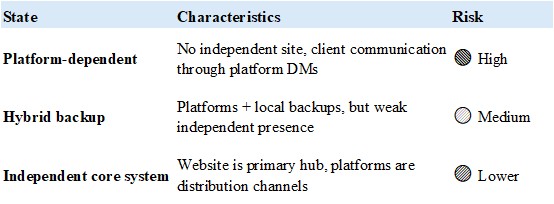
The goal is not to “escape platforms,” but to avoid being locked into them.
7. Actionable Framework: A Resilient Portfolio Architecture
Here is a practical three-layer structure you can implement immediately.
① Display Layer (Platforms)
Function: Exposure, discovery, engagement
Mindset: “Borrowed stage”
Principle: Never assume permanence
Actions:
l Use platforms actively but do not treat them as archives
l Redirect serious inquiries to your own channels
l Treat platform content as previews, not final portfolio
② Structural Layer (Self-Owned)
Function: Curation, narrative, long-term accessibility
Form: Personal website or structured documentation
Principle: You control sequencing, not algorithms
Actions:
l Organize by projects/series, not timelines
l Each series includes: work, intent, context, references
l Ensure SEO indexability for independent discovery
l Update regularly (at least quarterly)
③ Asset Layer (Local/Cloud Backup)
Function: Raw files, metadata, legal proof
Principle: Fully isolated storage
Actions:
l Separate RAW files from display versions
l Preserve full metadata (location, time, equipment, story)
l Use 3-2-1 backup strategy: 3 copies, 2 media types, 1 offsite
Maintenance Checklist
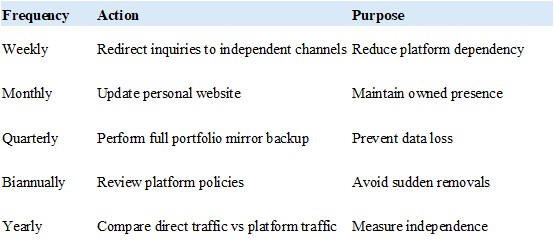
FAQs
1. Should photographers stop using Instagram or similar platforms entirely?
No. These platforms are still effective discovery and distribution channels. The key is not dependence, but diversification.
2. Is building a personal website enough to replace social platforms?
A website provides ownership and stability, but it does not replace network effects. It should complement—not replace—platform distribution.
3. Do platforms legally own my photos once uploaded?
Most platforms do not take ownership, but their terms often grant broad licensing rights for hosting, distribution, and algorithmic processing.
4. Can deleted or hidden platform content be fully recovered later?
Not always. Even when downloadable, structure, metadata relationships, and external indexing are often lost.
5. What type of photographers are most at risk?
Those relying exclusively on one platform for exposure, client acquisition, and portfolio hosting without independent infrastructure.
References
1. Meta Platforms, Inc. (2024). Instagram Terms of Use. https://privacycenter.instagram.com/policy
2. Behance (Adobe Inc.). (2023). Terms of Service and Content License Agreement. https://www.behance.net/misc/terms
3. 500px. (2023). Terms of Service. https://500px.com/terms
4. Gillespie, T. (2022). Custodians of the Internet: Platforms, Content Moderation, and the Hidden Decisions That Shape Social Media. Yale University Press.
5. van Dijck, J., Poell, T., & de Waal, M. (2018). The Platform Society: Public Values in a Connective World. Oxford University Press.
6. Srnicek, N. (2017). Platform Capitalism. Polity Press.
About the Author
Oliver Grant
Focus: Legal Risks, Privacy, Real-World Incidents
Oliver Grant writes about the legal and ethical boundaries of photography, with a focus on privacy, liability, and real-world risk scenarios. His work examines what can go wrong—and how photographers can protect themselves before it does.
Editorial Transparency Statement
This article is based on widely observable platform behaviors, publicly available terms of service, and established research on digital platforms and algorithmic content distribution. It does not rely on confidential data, internal platform systems, or proprietary analytics.
Interpretations regarding “algorithmic restructuring,” “visibility decay,” and “portfolio fragmentation” are analytical frameworks intended to help photographers understand systemic risks in platform-dependent workflows. They should not be interpreted as descriptions of internal platform code or exact ranking mechanisms.
All examples are conceptual and illustrative rather than case-specific claims.
Disclaimer
This content is for informational and educational purposes only and does not constitute legal, financial, or professional advice. Platform policies, algorithms, and terms of service may change over time, and readers are encouraged to consult official documentation for the most current information. The author and publisher assume no liability for decisions made based on this article.
Recommend:
Why Nobody Buys Your Photos—Even After You Upload Them Everywhere
You Tried Shooting Product Photos at Home—But They Look Cheap
How to Set Up a Reliable Photography Workflow from Shooting to Delivery

Why Sharpness Doesn’t Fix Boring Plant Photos (Even with Expensive Gear)