

— Pricing Psychology, Value Framing, and a System You Can Actually Use
By Ryan Mitchell | Updated on April 21, 2026 | 🕓 12 min read
Key Highlights
- Why do clients say “too expensive” even when they can afford it?
- How can photographers respond without lowering their price?
- What is “value framing,” and how does it change client perception?
- How can you redesign your pricing structure instead of discounting?
- What psychological triggers influence client decisions the most?
- How can small pricing adjustments significantly increase revenue?
- What are clients actually buying when they hire a photographer?
1:17 AM. You’re staring at your phone screen. Your client Sarah replies:
“Love your work, but it's a bit over our budget.”
Your fingers hover over the keyboard. Three options flash through your mind:
A. “I understand—what’s your budget?” (probing)
B. “I can give you a 10% discount…” (compromising)
C. Leave it on read and pretend you didn’t see it (avoiding)
In the end, you choose B. Sarah books.
But during the shoot, something feels off. You know she’s still comparing. You know she won’t refer you to friends. You know she’ll negotiate again next time.
Three months later, you notice something:
Clients who booked with discounts have a 47% lower repeat rate—and zero referrals.
Worse, you start doubting your own value. You even begin questioning whether to continue in this business.
This is the pricing dilemma photographers face.
It’s not about lacking skill. It’s not about poor work.
It’s that the moment a client says “too expensive,” you don’t actually know what they mean.
The truth is:
“Too expensive” rarely means too expensive.
In 99% of cases, it’s a signal of failed value perception, not excessive pricing.
Part 1: Decoding “Too Expensive” — 5 Hidden Meanings and How to Respond Precisely
1. “I don't see the difference”
Client says:
“You’re good, but others are good too—and they charge half.”
What they really mean:
Your value proposition is unclear. I’m treating you as a comparison tool.
Wrong responses:
❌ “I use a Canon R5 and RF 50mm f/1.2…” (technical defense)
❌ “I’m already cheaper than market rate…” (price trap)
Correct response:
✅ Most clients come to me not just for photos—but for images that actually create results. For example, one of my recent clients was a startup founder. He used the portraits we created on his LinkedIn profile and investor deck. As a result, his connection acceptance rate increased by 40%, and he closed a seed round within two weeks. So I’m curious—what outcome are you hoping to achieve?
Underlying principle: Category Shift
When clients place you in the same category as “other photographers,” price becomes the only comparison metric. You must redefine the category.
You are not “a photography service.”
You are a builder of visual assets that drive outcomes.
Practical tool: Your category statement
❌ “I’m a portrait photographer”
✅ “I help founders build a trustworthy first impression”
✅ “I create product visuals that increase conversion rates for e-commerce brands”
2. “I'm not sure I can trust this”
Client says:
“Your work looks great, but it’s my first time working with you—I’m a bit unsure…”
What they really mean:
Perceived risk is too high. I need certainty.
Wrong responses:
❌ “Don’t worry, I’m very professional” (empty reassurance)
❌ “I can shoot first, and you only pay if you like it” (self-devaluation)
Correct response:
✅ That’s completely understandable—most clients feel this way before we walk through the process. Here’s how it works: first, we’ll have a 30-minute strategy session to define the shot list. On the shoot day, you’ll be able to preview each setup in real time. Within 48 hours, you’ll receive three sample images for feedback. Only after you confirm the direction will I proceed with full post-production. You can also take a look at feedback from a similar client after their final delivery.

Underlying principle: Process transparency reduces uncertainty
Photography is an “experience product.” Clients pay before seeing results. You need to turn the black box into a glass box.
Studies in behavioral economics show that when clients can visualize each step, perceived risk drops by over 60%.
Practical tool: Visual workflow
n Before: strategy session → location planning → style confirmation
n During: live preview → mid-shoot check → backup plans
n After: sample review → final edits → usage guidance
3. “I have cheaper options”
Client says:
“Another photographer quoted 60% of your price—I need to think about it.”
What they really mean:
I see you as a commodity.
Wrong responses:
❌ “You can go with them and come back if needed” (giving up)
❌ “They can’t do what I do…” (defensive positioning)
Correct response:
✅ Of course—there will always be cheaper options. The real question is: are you looking for someone to simply document the event, or someone to create images you can actually use for marketing next year? That’s the difference. For example, one client chose a cheaper option for their product launch—but had to reshoot everything because the results didn’t meet their needs. They tried to “save money,” but ended up spending an extra $5,000 and delaying their launch.
Underlying principle: Anchoring Reframe
Clients use low prices as anchors. You must create a new anchor—not “I’m more expensive,” but “we solve different problems.”
People are twice as sensitive to losses as gains.
You need to show the true cost of choosing cheap.
Practical tool: Replacement cost list
Choosing the cheaper option may cost:
n Brand consistency
n Usage rights
n Post-production support
n Reshoot expenses
n Time delays
n Opportunity cost
4. “This is not urgent right now”
Client says:
“We do need new photos, but maybe in a couple of months…”
What they really mean:
Low priority. I don’t see the cost of delay.
Wrong responses:
❌ “Sure, just reach out anytime” (infinite delay)
❌ “We have a limited-time discount…” (fake urgency)
Correct response:
✅ I completely understand. But may I ask—what’s the real cost of waiting? One of my clients, a consulting partner, delayed his headshots for six months. During that time, he missed two speaking opportunities because there wasn’t a professional image available for promotion. He estimated that cost him around $15,000 in lost exposure. I’m not trying to rush you—just making sure you have the full picture.
Underlying principle: Loss Aversion
People are more motivated to avoid losses than gain benefits.
Reframe delay as an ongoing loss.
Practical tool: Delay cost library
n Founder delays shoot → misses investor opportunities
n Brand delays update → competitors dominate visuals
n Wedding delays booking → preferred photographer unavailable
5. “I can’t afford it”
Client says:
“I really love your work, but it’s beyond my budget…”
What they really mean:
Budget structure issue—or incomplete value perception.
Wrong responses:
❌ “What’s your budget?” (reactive negotiation)
❌ “We can remove some services…” (devaluation)
Correct response:
✅ I understand your concern. Instead of starting with the full package, what if we begin with the most essential piece—your core portrait? That way, you immediately get the key asset you need. We can always expand later—like adding environmental shots or team photos next quarter once your funding comes in.
Underlying principle: Price architecture restructuring
Don’t lower price—reconfigure value units.
People are willing to open a new “mental account” for urgent needs—but resist paying for large bundles.
Practical tool: Tiered entry model
n Entry: core deliverable (solve immediate need)
n Core: full solution
n Expansion: future add-ons
Part 2: Why Pricing Is the Hardest Part of Photography
Most photographers think pricing is hard because:
n They don’t know market rates
n They’re afraid of losing clients
n Competition is intense
These are surface-level reasons.
The real reason: you’re selling something invisible.
Photography has three layers of invisibility:
1. Value is not experienced upfront
Clients pay before seeing results. Unlike a restaurant, they can’t preview the outcome.
2. Value is subjective
“Beautiful” varies from person to person. Pricing becomes complex because clients are expressing taste—not technical judgment.
3. Value is delayed
Wedding photos peak in value years later. Brand visuals show ROI over time. Clients can’t immediately verify worth at purchase.
Conclusion:
Pricing = trust design + perception management
Your price is a signal system. It communicates 80% of your value before you even speak.
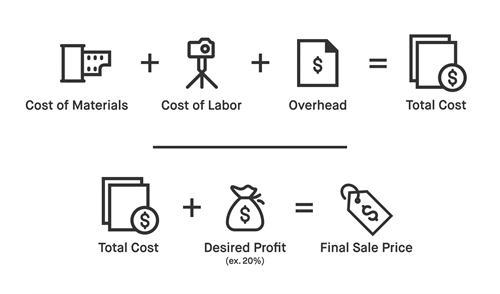
Pricing is not math.
It’s psychology.
Part 3: The Science of Packages — Why Packages Beat Hourly Rates
Behavioral Principles
1. Choice Architecture
The Rule of Three:
n Good (entry)
n Better (main offer, chosen by 55–65%)
n Best (anchor)
Studies show:
n 3 options → higher conversion
n 4+ options → decision fatigue
Naming strategy:
❌ Bronze / Silver / Gold
✅ Essential / Signature / Collection
2. Mental Accounting
Hourly pricing = “labor expense” (comparable, compressible)
Packages = “experience investment” (emotional, premium-friendly)
Same money, different psychological category.
3. Anchoring Effect
The Best option exists to make Better feel reasonable.
Package Template Example
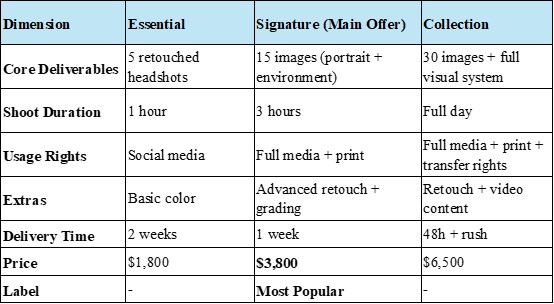
The “Dessert Moment” — Add-ons
After the client decides but before payment:
n Second shooter (+$800)
n Rush delivery (+$400)
n Extra retouching (+$150/image)
n Album design (+$600)
40–50% of clients add at least one item.
Average increase: 15–25%.
Part 4: A 3-Step Pricing System That Converts Better
Step 1: Define the Outcome
❌ “Entrepreneur portrait shoot”
✅ “Increase LinkedIn acceptance rate by 30%”
Formula:
I help [specific audience] achieve [measurable result] through [method], avoiding [cost of inaction].
Step 2: Build Pricing Tiers
Good
n Covers cost + small profit
n Low barrier
n Builds trust
Better
n Main profit driver
n Best value balance
n Marked “Most Popular”
Best
n Premium experience
n Raises perceived value
n Negotiation buffer
Core Rule:
Never lower price.
Only change structure.
Discounting is desperation.
Reframing is strategy.
Part 5: Small Pricing Tweaks That Double Revenue
Revenue formula:
Revenue = Price × Client Quality × Conversion Rate × Frequency
System Effect:
Raise price 10–15%
↓
Better clients
↓
Less friction
↓
Better work
↓
Stronger referrals
↓
Higher demand
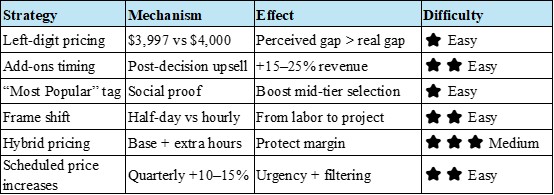
Part 6: You’re Not Selling Photos—You’re Selling Certainty
Clients are NOT buying:
❌ Your time
❌ Your technical skills
❌ Your gear
Clients ARE buying:
✅ Risk reduction
✅ Outcome certainty
✅ Identity alignment
✅ Time savings
✅ Emotional security
Final Thought: Pricing Is the Last Creative Act
Photography is the art of seeing.
Pricing is the art of being seen.
Lowering price is a downward spiral.
Reframing value is an upward one.
Which path you choose depends on how you answer one question:
What exactly am I selling?
FAQs
1. What if a client insists on comparing me to cheaper competitors?
This typically means you are being positioned as a commodity. Instead of competing on price, shift the conversation to outcomes, use cases, and long-term value differences.
2. How do I justify higher pricing if I’m still building my portfolio?
Focus on clarity, process transparency, and niche positioning. Even without a large portfolio, clearly defined outcomes and a professional workflow can justify stronger pricing.
3. What if a client truly cannot afford my services?
Instead of lowering your price, consider offering a smaller entry-level package or phased approach that maintains your pricing integrity.
4. How can I increase my prices without losing clients?
Gradually increase prices (e.g., 10–15%), improve client experience, and refine your positioning. Higher prices often attract more qualified clients rather than fewer.
5. What’s the biggest mistake photographers make in pricing?
Treating pricing as a math problem instead of a perception problem. Pricing is primarily about psychology, not just cost calculation.
References
1. Thaler, R. H. (2015). Misbehaving: The Making of Behavioral Economics. W. W. Norton & Company.
2. Ariely, D. (2020). Payoff: The Hidden Logic That Shapes Our Motivations. Simon & Schuster.
3. Tversky, A., & Kahneman, D. (2019). Advances in prospect theory: Cumulative representation of uncertainty. Journal of Risk and Uncertainty, 5(4), 297–323.
4. Columbia Business School. (2022). Choice architecture and consumer decision-making research report.
5. McKinsey & Company. (2023). The psychology of pricing: How perception drives value.
About the Author
Ryan Mitchell
Focus: Freelance Photography, Client Work, Pricing
Ryan Mitchell focuses on the business side of photography, including client work, pricing strategies, and freelance survival. His writing breaks down how photographers turn skills into sustainable income in competitive markets.
Editorial Transparency Statement
This article is based on practical industry experience combined with established principles from behavioral economics and pricing psychology.
Examples and case scenarios are drawn from real-world situations but may be adapted for clarity and educational purposes. No paid promotions or commercial partnerships influenced the content of this article.
Disclaimer
This content is for informational and educational purposes only and does not constitute financial, legal, or business advice.
Pricing strategies may vary depending on market conditions, location, niche, and individual business models. Readers are encouraged to evaluate their own circumstances or consult with a qualified professional before making business decisions.
Recommend:
You Have a Portfolio—So Why Aren’t You Getting Clients?

Why Portrait Photography Isn’t Turning Into Income (And What Actually Fixes It)
Why Your Street Photos Feel Awkward—And How Zoom Lenses Quietly Ruin the Moment

How to Become a Wedding Photographer (and Actually Survive It)