
By Ethan Cole | Updated on March 05, 2026 | 🕓 7-8 min read
Key Highlights
- Do you really need multiple lenses to shoot professionally?
- What focal length covers most real-life scenarios?
- Is a zoom lens or a prime lens better for daily use?
- Is f/2.8 or f/1.4 essential?
- What matters more: image quality or portability?
- What’s the biggest mistake beginners make?
When I first started in photography, I believed in the idea that “more is more.”
The more focal lengths you have, the more professional you become. So I bought a 16–35mm, a 24–70mm, a 70–200mm, and even a few fast prime lenses. Only then did I feel “complete.”
And what happened?
Before going out, I couldn’t decide which lens to bring. I carried three lenses, constantly switching them. I missed moments. My shoulders hurt.
Even more ironically, when I later reviewed my photos from the past year, more than 80% were taken with the same single lens.
This question stayed with me for a long time:
If you could only keep one lens, which one would actually allow you to shoot almost everything you encounter in real life?
After years of street, travel, and commercial photography, my answer might surprise you.
I. The “80% Rule” in Photography
Let’s start with a simple fact.
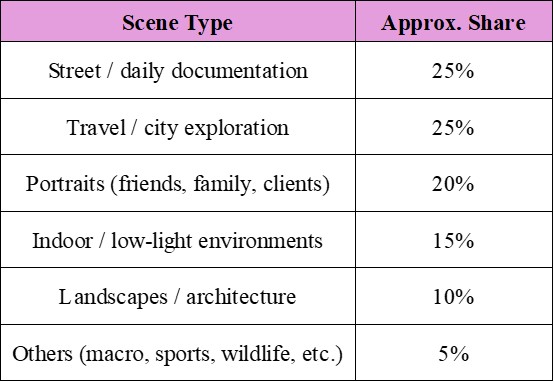
For most photographers, the distribution of everyday shooting scenarios looks roughly like this:
First insight:
The 80% of situations above actually require very similar focal lengths—mostly between 24mm and 105mm (full-frame equivalent). Ultra-wide or extreme telephoto is rarely needed in daily use.
Second insight:
Most photographers (including my past self) only repeatedly shoot a small subset of situations. We think we need to “cover everything,” but in reality, we only revisit a few familiar scenarios.
Professional photography is not about having more lenses.
On the contrary, more lenses often mean higher decision cost, lower willingness to carry gear, and ultimately fewer photos taken.
I’ve seen many people spend years collecting gear that ends up sitting unused in dry cabinets.
So the real question is not “which lens is best,” but:
Which lens will you actually carry, and consistently use in real life?
II. What Is a Truly “Versatile Lens”?
Let’s correct a common misconception.
Many people think a “do-it-all lens” means a lens that can do everything—ultra-wide landscapes, long telephoto wildlife, macro flowers, creamy portrait blur… all in one.
That expectation is unrealistic.
There is no such lens.
A truly versatile lens is simple:
Not the best lens, but the one you use the most.
Based on this definition, I focus on three key criteria:
1. Focal Length Practicality
It’s not about “wide coverage,” but whether the covered range is actually useful.
A superzoom like 18–300mm may look impressive, but it compromises sharpness and aperture at both ends. In contrast, a 24–105mm or 24–120mm may seem less “extreme,” but every focal length within it sits in a highly usable real-world range.
2. Real-World Aperture Utility
Don’t just look at f/1.4 vs f/2.8.
Ask yourself:
How often do you actually need f/1.4 in real shooting situations?
Portrait photographers may use it frequently. But for street and travel, f/4 is often more practical—it’s lighter, cheaper, and sufficient in most lighting conditions.
From my experience, a constant f/4 zoom with image stabilization can handle 80% of real-world scenarios without issue. The remaining 20% of extreme low light can be handled with post-processing or supplemental lighting.
3. Weight and Carry Frequency
This is the most overlooked factor—but also the most important.
A 1.5kg lens, no matter how sharp, is useless if you rarely bring it with you.
A 400g lens, even if not perfect, can produce thousands of photos simply because it stays on your camera.
Carry frequency > ultimate image quality.
This is something most photographers only realize after years of experience.
III. Focal Length Strategy: Three Main Approaches
Option A: Wide-to-Standard Zoom (24–70mm or 24–105mm equivalent)
Best for: Travel, street, environmental portraits, daily documentation
This is the most common “single-lens solution.”
Pros:
l Most versatile coverage (24mm for architecture and landscapes, 70–105mm for portraits and detail shots)
l Flexible composition without changing position
l No lens swapping, uninterrupted shooting flow
Cons:
l Limited telephoto compression
l No ultra-wide (below 24mm), restricting extreme landscapes
Realistic evaluation:
If you can only choose one lens, this is the safest option. Not exciting—but reliable.
Option B: Standard Prime (35mm or 50mm)
Best for: Daily documentation, documentary style, photographers who want to improve composition skills
Pros:
l Extremely lightweight (many 35mm lenses are 200–300g)
l Large aperture (f/1.4 or f/1.8) performs well in low light and for subject separation
l Fixed focal length forces you to move and think, improving composition
Cons:
l Limited flexibility (tight spaces or architecture can be challenging)
l Cannot reach distant subjects
Realistic evaluation:
This is the purest form of “minimalist photography.” You sacrifice flexibility for portability and image character. Ideal for those who know their intent.
Option C: Medium Telephoto Zoom (70–200mm equivalent)
Best for: Portraits, events, clean composition
Pros:
l Strong compression for clean backgrounds
l Excellent for candid or distant shooting without disturbing subjects
Cons:
l Heavy and inconvenient for daily carry
l Lacks wide-angle coverage for indoor or street photography
Realistic evaluation:
As a sole lens, it’s too limiting for most people. Better as a second lens.
IV. Zoom vs Prime: Stop Asking “Which Is Better”
This debate has lasted 20 years, but there is no absolute answer. Instead, here is a decision framework:
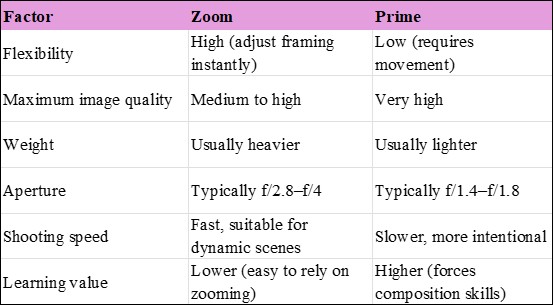
My simple recommendation:
l If you shoot street, travel, or events → zoom lenses are more practical
l If you focus on daily storytelling or artistic work → primes are more valuable
There is no right or wrong—only what fits your shooting habits.
V. Decision Model: How to Choose Your “One Lens” in 3 Steps
Step 1: Honestly evaluate your main shooting scenarios
Look at your last month of photos and identify your top categories:
l 70% street photography → 35mm prime or 24–70mm zoom
l 70% travel → 24–105mm or 24–120mm zoom
l 70% portraits → 50mm or 85mm prime (but 50mm is more versatile if only one lens is allowed)
l mixed usage → 24–70mm or 24–105mm is safest
Step 2: Choose lens type first, not brand
Don’t start with Sony, Canon, or Nikon.
First decide:
l Zoom or prime?
l f/2.8 or f/4?
l Lightweight or high performance?
Brand comes last.
Step 3: Accept the 20% trade-off
No single lens covers everything.
Choosing a 24–105mm means accepting weaker low-light performance than primes. Choosing a 35mm prime means giving up distant subjects. Choosing a 70–200mm means sacrificing indoor flexibility.
This is not loss—it is clarity.
Every trade-off reflects a clearer understanding of your real needs.
VI. Recommended “Single Lens Setup” (By Photographer Type)
These are not product recommendations, but focal-length-based strategies.
Street / Urban Photographer
Primary: 35mm prime (f/1.8 or f/2 is enough)
Alternative: 24–70mm f/2.8 or lightweight 24–50mm zoom
Why:
35mm closely matches natural human vision. It feels realistic and immersive. Lightweight gear encourages long walks and spontaneous shooting.
Travel / General Use
Primary: 24–105mm f/4 or 24–120mm f/4 equivalent
Alternative: 24–70mm f/2.8 (if budget allows and weight is acceptable)
Why:
24mm handles landscapes and architecture, 50–70mm handles portraits, and ~100mm captures details. One lens covers almost all travel scenarios.
Portrait-Focused Users
Primary: 50mm f/1.8 or f/1.4
Alternative: 85mm f/1.8 (but 50mm is more versatile if only one lens is allowed)
Why:
50mm works both indoors and outdoors and can also handle street photography. 85mm is more specialized and restrictive in tight spaces.
VII. What You Actually Lose (Be Honest)
If you choose a single-lens setup, you will lose:
❌ Ultra-wide impact
(16mm dramatic perspective for architecture or astrophotography)
❌ Telephoto compression
(200mm+ spatial compression and distant detail capture)
❌ Extreme background blur
(f/1.4 “creamy” bokeh cannot be matched)
❌ Low-light flexibility
(fast primes perform better in very dark environments)
These missing scenarios account for roughly 20% of shooting situations.
The real question is:
Are you willing to carry multiple lenses for that 20%?
For me, the answer is no.
I prefer to master the 80% with one lens, and either adapt or skip the rest.
VIII. A Real Photographer’s Data
Over the past two years, I analyzed all my exported “final keeper” images:
l 24–105mm f/4 equivalent → 67%
l 35mm f/1.8 → 18%
l All other lenses combined → 15%
This surprised me.
I originally assumed primes would dominate.
But in hindsight, it makes sense:
Most daily photography is about capturing moments—not achieving technical perfection.
A lightweight, stabilized, versatile zoom lens naturally becomes the most-used tool.
Of course, this won’t be the same for everyone. The key is to analyze your own data.
Look at your favorite photos from the past year—and see which lens created them.
The answer is already there.
IX. Practical Buying Checklist for Your First Versatile Lens
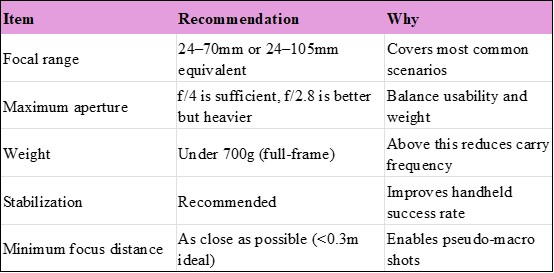
Equivalent lens logic across systems
l Full-frame: 24–70mm f/4 or f/2.8, 24–105mm f/4, 24–120mm f/4
l APS-C: ~16–50mm or 17–70mm equivalent
l Micro Four Thirds: ~12–40mm f/2.8 or 12–60mm
Focus on focal length equivalence, not brand.
X. Conclusion
After years of using different gear, I gradually realized something important:
Constraints can be freeing.
When you only carry one lens, you stop asking “which lens should I use?”
You start asking “how should I shoot?”
Your attention shifts away from gear—and toward light, composition, timing, and emotion. The things that actually give a photo life.
Using one lens is not a limitation. It is a focus training system.
Start simple. Shoot more. Improve naturally. Upgrade later.
If you are currently deciding which lens to buy, ask yourself:
Which focal length appears most often in the photos you truly love from the past three months?
That answer is the lens you should keep.
Frequently Asked Questions
1. Is a 24–105mm lens better than a 24–70mm?
It depends on your priorities:
24–105mm → More versatility and reach (better for travel)
24–70mm → Better low-light performance (especially at f/2.8)
If you prefer flexibility over speed, 24–105mm is often the better single-lens choice.
2. Should beginners start with a prime lens or a zoom lens?
Zoom lens → Easier to use, more forgiving, better for learning different compositions quickly
Prime lens → Better for developing composition skills and understanding perspective
If you’re unsure, start with a zoom.
3. Is f/4 enough for low-light photography?
In many cases, yes—especially with modern cameras and image stabilization. However, for very dark environments or artistic shallow depth-of-field effects, a faster lens (f/1.8 or f/1.4) is still advantageous.
4. What lens is best for travel photography?
A 24–105mm or 24–120mm equivalent lens is widely considered the best all-in-one travel option due to its flexibility across landscapes, portraits, and details.
References
1. Freeman, M. (2020). The Photographer’s Eye: Composition and Design for Better Digital Photos. Routledge.
2. Kelby, S. (2021). The Digital Photography Book (Vol. 1–5). Rocky Nook.
3. National Geographic. (2022). Complete Photography Guide: How to Take Better Photos. National Geographic Society.
4. Cambridge in Colour. (2023). Understanding Camera Lenses. Retrieved from [https://www.cambridgeincolour.com]
5. DPReview. (2024). Lens Buying Guide: Choosing the Right Lens for Your Photography. Retrieved from [https://www.dpreview.com]
6. Petapixel. (2023). Why Most Photographers Only Use One Lens Most of the Time. Retrieved from [https://petapixel.com]
About the Author
Ethan Cole
Focus: Tools, Camera Systems, Workflow Efficiency
Ethan Cole is a photography technology writer focused on camera systems, lens selection, and practical shooting setups. His work explores how photographers build efficient, flexible toolkits that reduce friction in real-world shooting—from everyday family moments to fast-changing travel scenarios.
Editorial Transparency Statement
This article is based on real-world shooting experience, long-term usage patterns, and practical observation rather than brand sponsorships or affiliate bias.
No manufacturers or companies influenced the content of this guide. All recommendations are based on usability, frequency of use, and commonly observed photographer behavior.
Where applicable, general industry knowledge and publicly available educational resources have been referenced to support accuracy.
Disclaimer
This article is intended for informational and educational purposes only.
Photography needs vary depending on individual style, environment, and professional requirements. The recommendations provided here are general guidelines and may not apply to every user.
Before purchasing any equipment, readers are encouraged to evaluate their own shooting habits, budget, and system compatibility.
Recommend:
How to Become a Wedding Photographer (and Actually Survive It)
Choosing a Versatile Lens for Everyday Photography (That Handles 80% of Work)
Event Photography: How to Start, Get Booked, and Actually Make It Worth It

Why Sharpness Doesn’t Fix Boring Plant Photos (Even with Expensive Gear)