

——Why Photographers Lose More Money on Paper Than Behind the Camera
By Oliver Grant | Updated on April 22, 2026 | 🕓 12 minutes
Key Highlights
- Who actually owns your photos after a shoot is finished?
- What do terms like “full rights” or “unlimited usage” legally mean?
- Can a client resell your images if your contract is vague?
- Is a verbal agreement ever enough in photography work?
- What happens if you deliver RAW files without clear terms?
- Could you unknowingly be classified as an employee instead of a freelancer?
- What are the minimum contract terms every photographer must include?
A wedding photographer shot bridal portraits for a newly married couple. She used a simple contract stating that the client would receive “full rights” to the images—but failed to define what those rights actually included.
Three years later, she discovered that the client had uploaded the photos to a stock platform, generating $3,000–$5,000 per month. After spending $18,000 in legal fees trying to stop the unauthorized commercial licensing, she learned the hard way: her original contract language was too broad to enforce any restrictions. In the end, she secured only a small share of future revenue.
Photographers master composition and light—but lose when it comes to “composing on paper.”
The law does not protect what you assumed. It protects what you clearly wrote.
Part 1: Ownership After the Shutter — Who Actually Owns the Photo?
1.1 The Default Rule: Photographers Own the Copyright — With One Major Caveat
Core fact: In most jurisdictions (U.S., UK, EU, China, etc.), photographers automatically own the copyright to their work unless there is a written transfer agreement.
However: This “default protection” only works if the photographer actively asserts it. Silence is not protection.
1.2 The Most Expensive Vague Terms (Ranked)
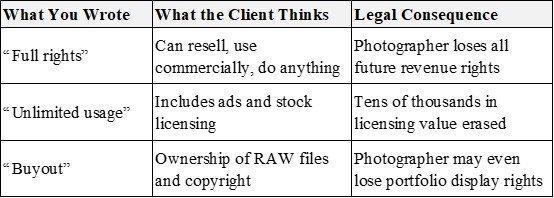
Case reference: Marcus Thompson’s “Corporate Portrait Disaster” — a client used LinkedIn headshots for a nationwide billboard campaign with over $200,000 in media spend. Due to an “unlimited usage rights” clause, Marcus had no legal claim.
1.3 Practical Tool: Copyright Clause Checklist
〇 Does it clearly distinguish between license and copyright transfer?
〇 Are usage scenarios specified (social media / print / ads / stock)?
〇 Does the photographer retain portfolio and attribution rights?
〇 Are territory and duration defined?
Recommended clause wording:
“Photographer retains copyright. Client is granted a non-exclusive, non-transferable license for [specific use, e.g., company website and social media only, for a period of 2 years].”
Part 2: Shooting Without a Written Agreement — Who Pays for the Mistake?
2.1 The Reality of Verbal Agreements in Court
Legal reality: Verbal agreements may be valid in some cases, but copyright transfer must be in writing.
The trap of implied license: Even if a court recognizes an implied license, its scope is unclear and non-exclusive—meaning the client doesn’t have full control, but neither do you.
2.2 The Risk Pyramid of “No Contract”
```
Bottom (common): Client refuses to pay, no enforcement basis
Middle (moderate): Client exceeds usage scope, impossible to prove original terms
Top (rare but severe): You’re classified as a “de facto employee,” losing tax advantages
```
2.3 A Counterintuitive Insight
Many photographers assume “shoot first, contract later” is normal. But data shows:
Around 70% of copyright disputes arise when rights are only clarified after project completion.
2.4 Practical Tool: Minimum Viable Written Agreement (5 Elements)
1. Parties and date
2. Description of the shoot
3. Deliverables (retouched images, format, RAW included or not)
4. Payment terms + copyright/license scope
5. Signature section
Part 3: When Clients Ask for “All RAW Files” — A Power Negotiation
3.1 RAW Files ≠ Deliverables — They’re Your “Negatives”
Industry norm: RAW files are considered intermediate creative assets, not final products.
Key question: Is the client buying photos or your entire creative process?
3.2 Why Giving RAW Files Can Mean Losing Control Forever
RAW files contain full editable data—clients can re-edit, crop, or even republish under someone else’s name.
Legal logic: If the contract doesn’t mention RAW files, photographers can refuse. But vague terms like “all files” may favor the client.
3.3 Smart Negotiation Strategy (Not Scripts)
Don’t say “no.” Say:
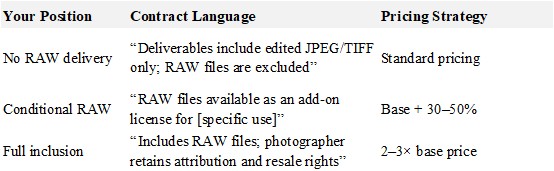
“I can provide RAW files, but it would require adjusting the licensing scope.”
Position RAW files as a premium add-on, not a default inclusion.
Explain it like this:
“Edited images are my signed work. RAW files are unfinished canvases—like asking a painter for their sketch drafts.”
3.4 Practical Tool: RAW File Clause Comparison
Part 4: Freelancer vs Employee — The Hidden Tax and Ownership Trap
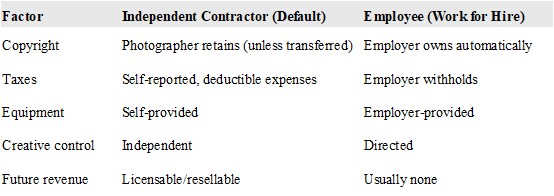
4.1 It’s Not What You Prefer — It’s What the Law Decides
Courts use a “control test” to determine status:
Who controls the work process, equipment, schedule, and tax obligations?
4.2 Legal Consequences by Classification
4.3 The “Disguised Employee” Trap
Scenario:
A client requires you to work full-time on-site, use their equipment, and follow fixed hours—yet labels you as an “independent contractor.”
Risk:
Authorities (like the IRS) may classify you as a de facto employee:
l Client owes back taxes and benefits
l You lose tax advantages
l Copyright ownership becomes disputed
4.4 Practical Tool: 7-Factor Status Self-Check
Adapted from Community for Creative Non-Violence v. Reid:
1. Who controls how the work is done?
2. Who provides the skill/expertise?
3. Who owns the equipment?
4. Duration of the relationship?
5. Can the client assign additional projects?
6. Payment structure (per project vs hourly vs salary)?
7. How are taxes and benefits handled?
If most answers point to the client—you may already be a de facto employee.
Part 5: A “Minimum Viable” Photography Contract Framework
Clause 1: Scope of Work
l Shoot details (content, time, location)
l Deliverables (number, format, RAW included or not)
l Clearly state what is not included
Replace vague terms:
l Remove: “full rights,” “buyout,” “all files”
l Replace with:
“Non-exclusive personal-use license limited to social media sharing and private printing. Commercial use or resale is prohibited.”
Clause 2: Payment Terms
l Total fee
l Deposit (30–50% recommended)
l Final payment timing (before or upon delivery)
l Late fee (e.g., 0.5% per day)
Clause 3: Delivery & Revisions
l Delivery timeline
l Revision limits (e.g., 2 rounds included, extra billed hourly)
l Client feedback deadline (e.g., 7 days, otherwise deemed approved)
Clause 4: Usage Rights (Most Critical)
l Copyright ownership
l Client license scope (use case, duration, territory, exclusivity)
l Whether sublicensing is allowed
l Photographer’s retained rights (portfolio, promotion, awards)
Build a usage-based pricing system:
```
Personal use (social / family) → Base price
Commercial use (website / brochures) → Base ×1.5
Advertising (billboards / TV / national campaigns) → Base ×3–10 or custom quote
```
Add enforcement protection clause:
Even after granting usage rights, retain the right to pursue third-party infringement independently.
Clause 5: Cancellation & Breach
l Client cancellation policy (e.g., deposit non-refundable within 7 days)
l Photographer cancellation terms
l Force majeure clause
A Practical Reality Check
Your first contract doesn’t need to be perfect—but it must exist.
A Google Doc is enough.
What matters is:
Write it down. Get it signed. Improve it after every project.
FAQs
1. Do I automatically own the copyright to my photos?
Yes, in most countries you do by default. However, if your contract includes vague or overly broad language, you may unintentionally transfer or weaken those rights.
2. Can a client legally resell my photos?
Only if your agreement allows it—explicitly or implicitly. Broad terms like “full rights” or “unlimited use” can give clients the ability to resell or commercially exploit your work
3. Should I give clients RAW files?
Not by default. RAW files should be treated as a premium add-on with clearly defined licensing terms, as they give clients significant control over your work.
4. What is the difference between a license and a copyright transfer?
A license allows the client to use your work under specific conditions, while a copyright transfer gives them full ownership—often permanently.
5. What is “work for hire” and why does it matter?
“Work for hire” means the client (or employer) automatically owns the copyright. If you’re classified this way, you lose all future rights to the images.
6. Can I still use my photos in my portfolio after delivering them?
Only if your contract explicitly allows it. Without a clause reserving portfolio rights, you may lose the ability to showcase your own work.
7. How long should usage rights last?
It depends on the project, but best practice is to define a clear time limit (e.g., 1–3 years) rather than granting indefinite usage.
References
1. U.S. Copyright Office. (2023). Circular 30: Works made for hire. [https://www.copyright.gov/circs/circ30.pdf]
2. American Society of Media Photographers. (2024). ASMP professional business practices in photography. [https://www.asmp.org]
3. European Union Intellectual Property Office. (2022). Copyright and related rights in the EU. [https://euipo.europa.eu]
4. Stim, R. (2023). Photography and the law: Rights and releases. Nolo Press.
5. World Intellectual Property Organization. (2023). Understanding copyright and related rights. [https://www.wipo.int]
About the Author
Oliver Grant
Focus: Legal Risks, Privacy, Real-World Incidents
Oliver Grant writes about the legal and ethical boundaries of photography, with a focus on privacy, liability, and real-world risk scenarios. His work examines what can go wrong—and how photographers can protect themselves before it does.
Editorial Transparency Statement
This article is based on a combination of industry practices, publicly available legal guidelines, and real-world case scenarios commonly encountered in photography work. While examples are representative, some details have been simplified for clarity and educational purposes. No commercial partnerships or sponsorships influenced the content of this article.
Disclaimer
This content is for informational purposes only and does not constitute legal advice. Laws and regulations vary by jurisdiction, and individual circumstances may differ. For specific legal concerns or disputes, consult a qualified attorney licensed in your region.
Recommend:

Family Photography Without the Fake: A Simple Setup for Capturing Real Life

When a Paid Shoot Goes Wrong: Who Pays for Gear Damage, Injuries, and Liability?

Event Photography: How to Start, Get Booked, and Actually Make It Worth It
The Hidden Risk of Building a Photography Portfolio on Third-Party Platforms